

Chong Wu Ling
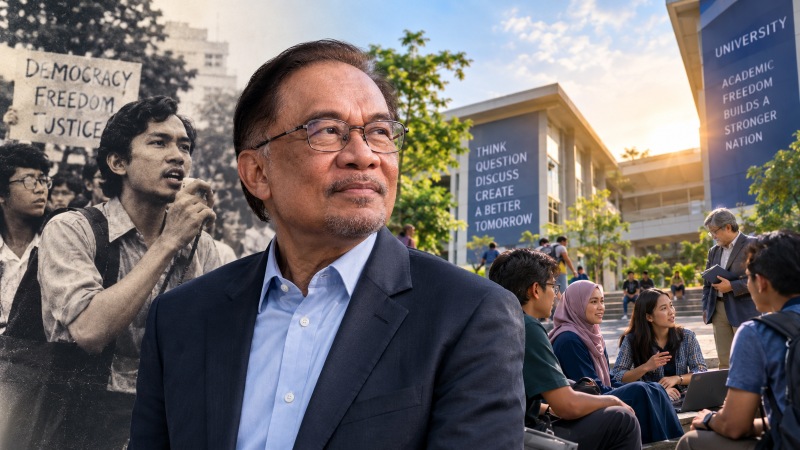
Anwar Ibrahim is the only prime minister to date with a student movement background who suffered injustice before taking office.
He certainly understands the value of freedom of expression and academic freedom better than any other prime minister before him.
Since he came to power in 2022, university students and academic staff have expected him to keep his long-held promises. They expect him to abolish restrictive laws such as the Universities and University Colleges Act 1971 (UUCA) and guarantee freedom of speech on campuses.
What Anwar has promised
In August 2026, Anwar announced that the government would abolish the UUCA without introducing any legislation that restricts or suppresses student movements. He said universities must be arenas for critical thinking and fresh ideas, even if such views are directed at those in power.
He also ordered public universities to drop disciplinary proceedings against students punished solely for criticising him or his government.
Anwar also said academics at public universities must be free to express and defend their views. Government regulations should not silence them simply because they are government staff.
- Sign up for Aliran's free daily email updates or weekly newsletters or both
- Make a one-off donation to Persatuan Aliran Kesedaran Negara (ALIRAN), Maybank a/c 507246118995 or CIMB a/c 8004240948
- Make a regular pledge or periodic auto-donation to Aliran
- Become an Aliran member
He added that universities must provide fully open space for research and academic inquiry, as long as academics can defend their views.
More recently, at an international summit for young future leaders in Kuala Lumpur, Anwar reiterated that no action would be taken against students who criticised him or the government. He said education aimed to cultivate critical thinking and students had to defend their position.
Although long overdue, this is welcome news for university students and academic staff.
Beyond abolishing UUCA
But abolishing the UUCA alone is not enough to achieve genuine academic freedom. Anwar must also address the working conditions of academic staff.
This is crucial because supportive working conditions are an integral part of genuine academic freedom. Without genuine academic freedom, academic staff cannot engage in meaningful knowledge production and effectively guide students in critical thinking.
In recent years, red tape and administrative duties have burdened academic staff at public universities in Malaysia. Increasingly stringent key performance indicators (KPI) add to the pressure, with a heavy focus on publications and research grants.
The red tape has significantly reduced the time academic staff spend preparing for high-quality teaching, research and supervision. The KPIs have led to authoritarian quantification, which reduces academic staff to tools for boosting institutional scores rather than generators of independent ideas.
In addition, reduced state funding for higher education compels public universities to increase student numbers. This applies especially to foreign students and local students who enrol through direct intake pathways and pay full tuition fees without government subsidies.
At the same time, recruiting new academic staff is often cumbersome and lengthy.
As a result, academic staff bear a heavier teaching and supervision load, on top of tedious administrative work and demands for publications and research grants.
To create a truly free academic environment, Anwar must make sure the government gives public universities enough funding. With adequate funding, university administrators would not feel compelled to generate revenue at the expense of teaching quality and the wellbeing of academic staff.
Bureaucratic procedures should also be streamlined, and redundant paperwork eliminated.
The Anwar government must also realise that the ‘publish or perish’ culture will only decrease academic self-efficacy. This culture focuses solely on the quantity of publications and the citation index.
Academic performance indicators should not only focus on quantitative output. They should also place greater emphasis on qualitative impact assessments.
In short, Anwar should use his leadership to promote genuine academic freedom. Abolishing the UUCA is not enough to cultivate a healthy academic environment.
Anwar must also make sure his government is committed to improving working conditions for academic staff, so they can focus on research and teaching. Only then can Malaysia truly achieve academic freedom.
Chong Wu Ling is a senior lecturer at the Department of Southeast Asian Studies, University of Malaya. She is also a member of the university’s Research Network on Human Rights. Her areas of expertise include ethnic Chinese studies, Southeast Asian politics and human rights.
This comment article is part of an ongoing research project titled ‘Leadership capital of Malaysian prime ministers in the post-2018 period’ (project number: UMGS028J-2025).
The views expressed in Aliran's media statements and the NGO statements we have endorsed reflect Aliran's official stand. Views and opinions expressed in other pieces published here do not necessarily reflect Aliran's official position.
- Tegakkan maruah serta kualiti kehidupan rakyat
- Galakkan pembangunan saksama, lestari serta tangani krisis alam sekitar
- Raikan kerencaman dan keterangkuman
- Selamatkan demokrasi dan angkatkan keluhuran undang-undang
- Lawan rasuah dan kronisme
