
Sayed Mohammad Reza Yamani Sayed Umar
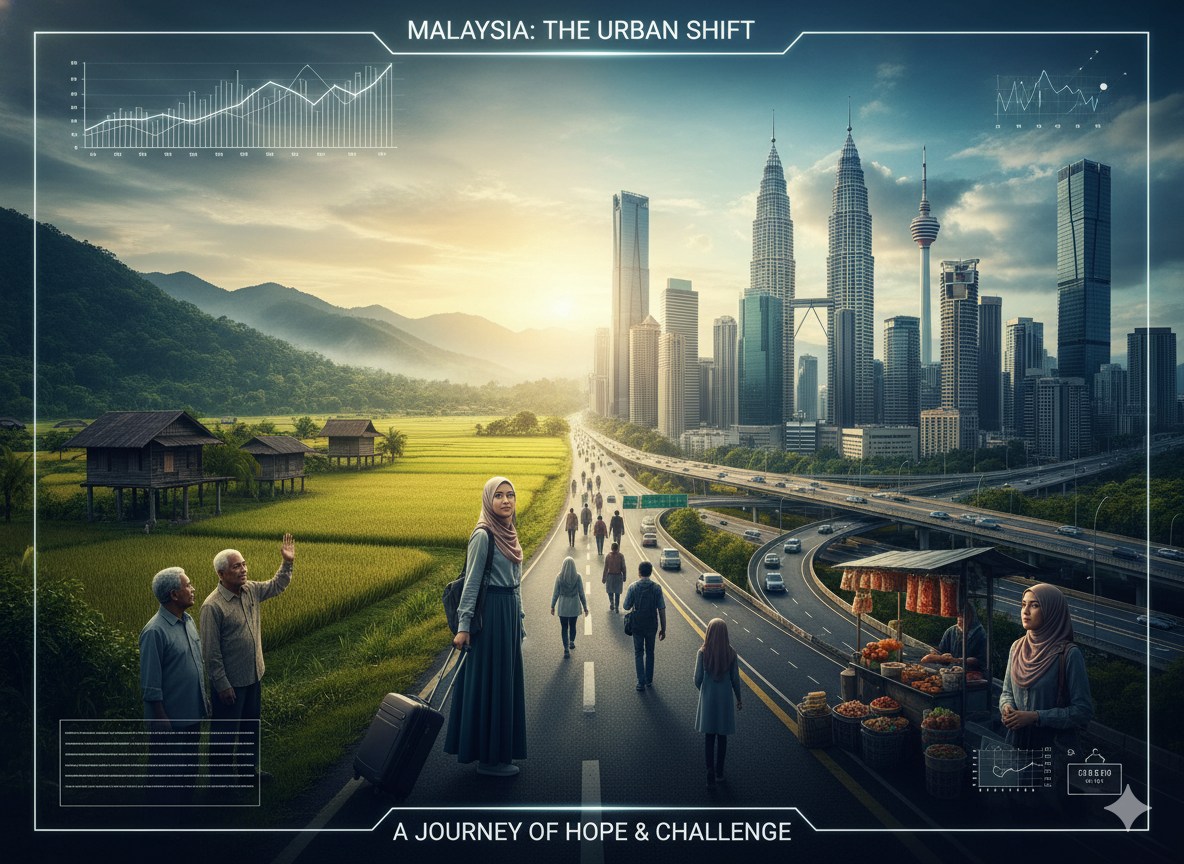
The movement of people from rural to urban areas in Malaysia is reshaping the country’s demographics and economy, and influencing job markets, living standards and social services.
Urban centres such as Kuala Lumpur, Johor Bahru and Selangor continue to draw in migrants.
But the trend also lays bare deep disparities between rural and urban areas –and raises urgent questions about what is being done to close the gap.
Heading for the city
The urbanisation trend has accelerated sharply. Around 79% of the population now live in urban areas, up from less than 70% in 2010.
- Sign up for Aliran's free daily email updates or weekly newsletters or both
- Make a one-off donation to Persatuan Aliran Kesedaran Negara (ALIRAN), Maybank a/c 507246118995 or CIMB a/c 8004240948
- Make a pledge or schedule an auto donation to Aliran every month or every quarter
- Become an Aliran member
Young people often migrate for better job prospects, education or family connections. Many do not return, since urban employment typically offers better wages than agricultural work.
City life brings its own challenges, though. Overcrowding, traffic congestion and overstretched public services are common complaints.
Many new migrants end up in low-paying jobs in sectors such as construction or cleaning. They struggle with high living costs, particularly rising rents, leading some to rethink the move.
According to Malaysia’s Migration Survey Report 2024, published by the Department of Statistics in December 2025, internal migration dominates the picture, accounting for 63.5% of total movement. The vast majority of that is urban-to-urban transfers (84.6%), compared with only 0.6% that is rural to urban.
States such as Johor, Selangor and Sabah record the highest internal migration rates. Kuala Lumpur remains a focal point for job availability and educational opportunities. Although rural-to-urban migration is not the dominant flow, it remains significant as younger people seek better employment and education.
Economic incentives – particularly higher wages in urban sectors compared with agricultural jobs – are a major pull factor, alongside family ties and environmental considerations.
Rural cost
Education, too, drives the trend, with many young people heading to urban centres for further study and often staying on after graduation.
The continuous outflow of working-age people takes a toll on rural areas. It weakens agricultural modernisation and small-business growth, and increases reliance on remittances from urban workers.
This makes local rural economies vulnerable to fluctuations in the cities. This, in turn, makes it harder for rural communities to sustain critical services such as healthcare, education and transport.
A cycle takes hold: inadequate rural infrastructure and declining job prospects spur more migration, deepening rural depopulation further.
In urban areas, rising internal migration intensifies competition for housing and public services. Rapid population growth pushes up housing costs and creates scarcity. New migrants often end up in informal or low-skilled jobs, worsening socioeconomic disparities and deepening spatial inequalities.
Fixing the imbalance
Addressing these challenges requires action on two fronts: relieving pressure on cities while making rural life more attractive.
Strategic urban planning should prioritise housing, transport and zoning, with a focus on affordable housing.
At the same time, rural development initiatives should target economic diversification and better infrastructure to empower local communities, reducing the need to migrate in the first place.
Investment in rural education, healthcare and essential services can help keep young people in their home regions by preparing them for local job markets. Better use of national migration data, meanwhile, can inform more targeted policymaking in high-migration areas.
The government has introduced rural development policies and its “Shared Prosperity Vision 2030” to improve rural infrastructure and economic prospects, with plans to transform some communities into mini-satellite cities.
Despite these efforts, implementation remains difficult. The ongoing drift towards cities calls for urgent action on affordable housing and on creating real incentives for rural industries.
The stakes are high. Malaysia’s rural-urban migration highlights the need for effective policies to match urban growth with rural development to preserve community ties and ensure fairer opportunities for all.
Sayed Mohammad Reza Yamani Sayed Umar is a research fellow at the Ungku Aziz Centre for Development Studies (UAC), University of Malaya.
AGENDA RAKYAT - Lima perkara utama
- Tegakkan maruah serta kualiti kehidupan rakyat
- Galakkan pembangunan saksama, lestari serta tangani krisis alam sekitar
- Raikan kerencaman dan keterangkuman
- Selamatkan demokrasi dan angkatkan keluhuran undang-undang
- Lawan rasuah dan kronisme
