

Ravindran Raman Kutty
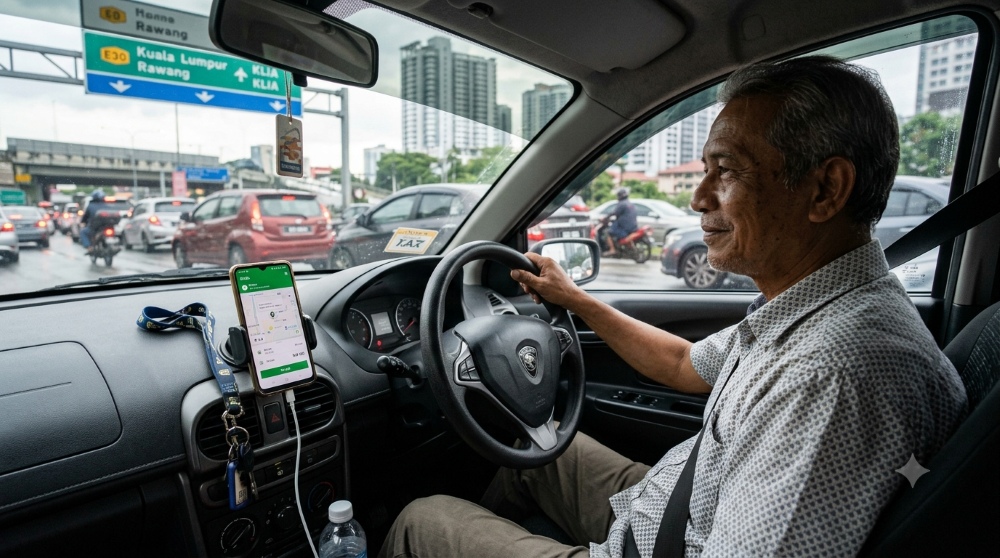
I met Ali over a simple lunch of rice, vegetables and two boiled eggs.
He is in his sixties, neatly dressed and soft-spoken, with a humour that tries to lighten what is clearly a heavy life. “Perut buncit sejak saya jadi drebar” (my belly’s got bigger since I became a driver), he joked, patting his stomach.
We laughed, but the fatigue around his eyes remained. What followed was not a grand theory of the ‘new economy’. It was a plain account of how one older person is trying to survive inside it.
Ali’s workday runs from mid-afternoon to midnight or sometimes 01:00. He wakes at about 10:00, does some light exercise, and washes his two-year-old Proton Saga himself before going out to look for lunch. He switches on the ride-hailing app at around 15:00.
“Dulu ok lagi” (it used to be okay), he told me. “Now I want to look for another job. But at my age, what job?”
Hidden costs
Ali’s story is full of costs that the rest of us rarely think about. Every kilometre means tyres wearing out faster, brakes needing more frequent servicing and more trips to the workshop.
- Sign up for Aliran's free daily email updates or weekly newsletters or both
- Make a one-off donation to Persatuan Aliran Kesedaran Negara (ALIRAN), Maybank a/c 507246118995 or CIMB a/c 8004240948
- Make a regular pledge or periodic auto-donation to Aliran
- Become an Aliran member
Petrol price movements and subsidy reforms immediately affect his take-home pay.
He cannot choose to opt out of peak-hour jams or long detours. He must go where the algorithm sends him.
Then there is the daily RM7.50 he pays for insurance – roughly RM2,500 a year – so that passengers are covered. It used to be cheaper, he said, but premiums went up as claims rose. For him, there is no real choice: “Kalau tak bayar, tak boleh jalan” (If I don’t pay, I can’t drive).
Tolls are a quiet drain. He pays upfront, often unsure if he’ll recover it. Every trip is a mental ledger – fare, fuel, tolls, wear and the hours he must add just to make it viable.
None of this features in the platforms’ glossy story of “efficiency” and “optimisation” – but it is the reality he drives through each day.
The rating system, presented as a tool for quality control, is another source of pressure. A thousand passengers can rate him five stars, but a handful of low ratings can drag his overall score down and affect his access to jobs and incentives. One irritated passenger with a bad day can outweigh months of careful service. For the passenger, it is a three-second tap. For Ali, it shapes his income for weeks.
More troubling is what happens when things go wrong. Ali describes the struggle to reach a real person, with support reduced to apps, FAQs and automated replies. But accidents, health scares and aggressive passengers do not wait for systems to catch up. “In an emergency, who do we call?” he asked.
At precisely the moment when a human voice is most needed, drivers like Ali are pushed back into the digital maze. This is not just a customer-service issue. It is a worker-safety issue that regulators and policymakers must treat as such.
Falling earnings
Ali’s earnings tell the clearest story. “I used to drive six to eight hours and could make RM250,” he said. “Now I have to drive eight to 10 hours just to hit the same RM250.”
Several changes sit behind that simple comparison. Under the old “my destination” feature, Ali could set Rawang as his end point. He could still pick up passengers roughly along the way home. The system recognised, in a small way, that a driver has a home and a family and cannot live entirely inside the app.
With the new zoning and “preferred area” features, he now often ends up in places like Selayang, Kepong or Damansara. There may be no trip offered in the direction of Rawang. The drive home is “balik kosong” (going home empty), with Ali paying the petrol and toll himself.
Platform commission has also increased from a flat 20% to around 25%, while incentive structures have become more complex and less generous.
A “streak” bonus during peak hours once clearly added RM10 or RM12 for a defined set of trips. Now he sometimes sees only about RM7 extra after RM80 worth of fares.
The language is about “balance” and “stability”, but he experiences it as more work for the same or less.
Even the digital backbone that is supposed to make all this efficient is unreliable. In certain areas, internet connections drop, GPS pins are inaccurate and the app freezes. He finds himself circling apartment blocks, trying to locate the correct gate, or stuck in basements with no signal at all.
The system does not compensate drivers for this dead time and lost mileage. Yet without drivers absorbing these losses, the promise of on-demand convenience for passengers would fall apart. From Ali’s seat, “optimisation” looks very much like a transfer of risk and cost from platform to worker.
Listening to Ali
Ali is not against the ride-hailing platform he uses, and neither am I. He acknowledges that the platform gave him and many others a way to earn when traditional jobs became harder to find, particularly during the pandemic. It has brought a measure of predictability and cleanliness to services that were once hit-and-miss.
But his story raises questions that go beyond one company.
For many older drivers, platform work is less a choice than a quiet necessity, yet age-sensitive protections remain unclear or absent.
The risks – accidents, health strain and unstable income – are real, but not evenly shared, and often borne most by the worker.
In a system that sends thousands onto our roads daily, the lack of guaranteed human emergency support raises serious concern.
And the promise of “flexible income” rings increasingly hollow. Sustaining it demands longer hours each passing year, just to stay in place.
These are not questions the algorithm can answer. They are questions for policymakers, regulators and platform owners – raised by voices like Ali’s, from the ground.
As we finished our meal, Ali spoke again of looking for another job, knowing how few options exist at his age.
I watched the discipline in his routine: the car he washes himself, the clean shirt, the late nights, the quiet calculations. Nothing about him felt like the carefree “gig worker” of policy reports.
If there is one thing I hope comes out of sharing his story, it is this: those designing policies and platforms should start by listening to people like Ali, not just to the language of optimisation and growth.
Until then, the least we can say is: terima kasih (thank you), Ali, for the rides, the patience in traffic and a reminder that each green dot on the map is a person, carrying burdens the app will never show.
Ravindran Raman Kutty, an Aliran reader, moves through everyday lives, listening closely and acting where he can to make things better.
The views expressed in Aliran's media statements and the NGO statements we have endorsed reflect Aliran's official stand. Views and opinions expressed in other pieces published here do not necessarily reflect Aliran's official position.
- Tegakkan maruah serta kualiti kehidupan rakyat
- Galakkan pembangunan saksama, lestari serta tangani krisis alam sekitar
- Raikan kerencaman dan keterangkuman
- Selamatkan demokrasi dan angkatkan keluhuran undang-undang
- Lawan rasuah dan kronisme

Very insightful and thought provoking. Thanks and terima kasih
I hope the writer forward the article to MOT, APAD. Good article.