

In February 2023, a number of oil and gas blocks were put forward for auction in the annual Malaysia Bid Round.
One of these blocks was the Bambazon Cluster. This cluster, located off the Northern coast of Sabah, consists of a ‘discovered resource opportunity’ (DRO, which is “located within a proven hydrocarbon basin and in close proximity to existing infrastructure, (…) offer(ing) synergistic development opportunities for monetisation“.
In January 2024, it was announced that a local energy company had signed a production sharing contract (PSC) for the Bambazon cluster. Geospatial analysis of maps of the Bambazon cluster sighted by RimbaWatch reveals that the easternmost field associated with the cluster is located entirely within the boundaries of the Tun Mustapha Marine Park (TMP).
Further analysis of zoning maps of the TMP identifies that the field is located in the commercial fishing zone of the park, and is close to some of the ‘preservation zones’ and ‘community use zones’ of the park.
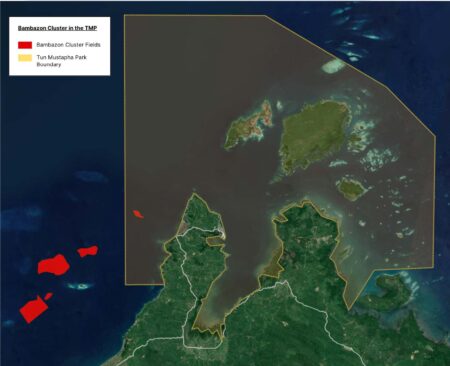
Figure 1: Bambazon Cluster in the TMP
- Sign up for Aliran's free daily email updates or weekly newsletters or both
- Make a one-off donation to Persatuan Aliran Kesedaran Negara (ALIRAN), Maybank a/c 507246118995 or CIMB a/c 8004240948
- Make a pledge or schedule an auto donation to Aliran every month or every quarter
- Become an Aliran member
The TMP is an International Union for the Conservation of Nature (IUCN) Category VI protected area.
According to the IUCN, Category VI protected areas are designed to “conserve ecosystems and habitats, together with associated cultural values and traditional natural resource management systems”, and therefore the TMP was planned to balance sustainable resource use and protection of ecosystem services and biodiversity, by promoting small-scale development and prohibiting industrial-scale activities, including through dividing the park into a number of zones with specific permitted uses.
According to the TMP’s zoning plans, the objective of the commercial fishing zone is to allow for “sustainable commercial fishing activities” and “small-scale sustainable and low-impact activities”. Therefore, only a limited number of activities are allowed in the commercial fishing zone, including “non-destructive traditional fishing methods, parasailing and sport fishing”.
Oil and gas activities are therefore contrary to the aims of establishing an IUCN Category VI protected areas, and are not in alignment with the zoning plans of the TMP, which only allow for sustainable, small-scale and low-impact activities.
Risks to biodiversity
It is widely recognised that oil and gas developments pose significant environmental risks to marine areas.
Impacts from the exploration phase can include acoustic impacts on marine mammal species and altered swimming behaviours on fish.
During the development phase, impacts include damage to the seabed and benthic organisms during drilling and discharge from drilling activities, including lubricants, damaging water quality and causing sedimentation.
In the production phase, other than potential impacts from discharge and the disposal of sledge, the risk of blowouts, leakage during transportation activities, oil spills and failure of infrastructure are significant.
The TMP is a globally significant biodiversity site. The TMP hosts over 82 species of hard corals, with a reef area of about 45,156ha. There are 715 fish species, more than 20 shark species, two dolphin species, and nesting sites for the Hawksbill and green sea turtles in the TMP; and over 17,000ha of mangroves.
In total, the waters of the TMP are inhabited by over 1,200 species, of which 180 are either vulnerable or endangered. All these species will be at risk from the impacts listed above.
It must be noted that these risks are not insignificant in Malaysia’s context, and major incidents related to oil and gas activities have occurred in recent years in East Malaysia, such as in May 2021 where an offshore oil rig sank while being assembled.
Further, according to Department of Environment data, 130 documented oil spills occurred in Malaysia’s waters between 2014 and 2022, with the top environmental impact being damage to marine life.
These risks are exacerbated by the fact that, despite advancements in oil spill remediation techniques, there remains no efficient and large-scale strategy to clean reefs affected by oil spills. Current methods are dominated by the use of chemical dispersants which can be more harmful to reefs than the oil itself.
Consider the ICJ advisory opinion
Fossil fuels are the primary driver of global emissions today, and the development of new fossil fuel resources, specifically fossil gas, is in direct conflict with scientific consensus on realistic 1.5C pathways, including the Intergovernmental Panel on Climate Change’s sixth assessment report.
These atmospheric realities underpinned the landmark legal ruling by the International Court of Justice in July 2025 on the obligations of states with respect to climate change. The ICJ ruled that states have a legal duty to prevent transboundary environmental harm, and failure to take measures to prevent foreseeable harm, including through the approval of new fossil fuel exploration licenses, could constitute a wrongful act attributable to the state.
Therefore, the approval of any exploration and production activities related to the Bambazon cluster by the government of Malaysia may constitute a violation of international law according to this landmark interpretation.
As an environmental think tank, RimbaWatch reminds relevant Malaysian authorities of its obligations under the Paris Agreement, strict interpretations of international climate law and its responsibility to the people of Malaysia to mitigate the worst impacts of climate change.
Given this, we urge the Sabah Parks Department to initiate steps to strengthen the Sabah Parks Enactment 1984 to exclude harmful activities, such as oil and gas exploration and production, in or near marine and coastal protected areas.
In the meantime, the department should ensure that oil and gas exploration in Block SB403, and the production from the Bambazon Cluster, does not transgress the Tun Mustapha Park.
Additionally, Malaysia’s oil and gas operators must commit to ending oil and gas activities in the Sulu-Sulawesi Marine Ecoregion and the Coral Triangle Implementation Area, in order to protect the most biodiverse marine ecoregion in the world.
Finally, the government of Malaysia must commit to a fossil fuel phase-out aligned with a global fair-share 1.5C pathway. In doing so, Malaysia should join other Global South energy players such as Colombia in calling for a fossil fuel non-proliferation treaty, which will establish a global framework for an equitable energy transition. – RimbaWatch
AGENDA RAKYAT - Lima perkara utama
- Tegakkan maruah serta kualiti kehidupan rakyat
- Galakkan pembangunan saksama, lestari serta tangani krisis alam sekitar
- Raikan kerencaman dan keterangkuman
- Selamatkan demokrasi dan angkatkan keluhuran undang-undang
- Lawan rasuah dan kronisme
