

Kua Kia Soong
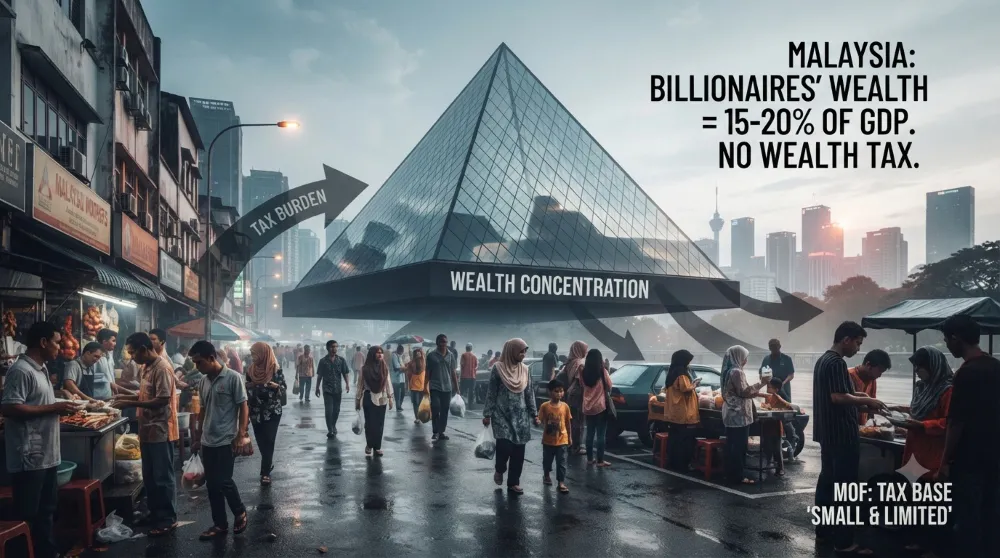
The Ministry of Finance recently said in a statement that Malaysia has “no plans” to introduce a 2% wealth tax, because the country’s tax base is “small and limited”.
But this raises a fundamental question. If the tax base is indeed narrow, why does the government continue to refuse to tax the greatest concentration of wealth in the country?
This argument is difficult to reconcile with the government’s repeated claims that Malaysia operates a progressive tax system.
A tax system cannot be genuinely progressive when the wealthiest people in Malaysia accumulate extraordinary fortunes, while the burden of funding public services falls mainly on workers, consumers and small businesses.
Wealth in very few hands
Malaysia is one of South East Asia’s more unequal societies in terms of wealth ownership.
According to Forbes’ annual billionaire rankings, Malaysia has around 25 billionaires, whose combined fortunes frequently exceed $80bn–100bn, depending on market valuations.
- Sign up for Aliran's free daily email updates or weekly newsletters or both
- Make a one-off donation to Persatuan Aliran Kesedaran Negara (ALIRAN), Maybank a/c 507246118995 or CIMB a/c 8004240948
- Make a regular pledge or periodic auto-donation to Aliran
- Become an Aliran member
Malaysia’s nominal gross domestic product (GDP) is now above US$500bn. This means the country’s billionaires alone control wealth equivalent to roughly 15-20% of Malaysia’s annual GDP.
This figure is remarkable. Fewer than 30 individuals possess wealth amounting to roughly one-fifth of everything produced by over 34 million people in Malaysia in an entire year.
This does not even include the country’s many centi-millionaires and ultra-high-net-worth families, who collectively own hundreds of billions more in property, financial assets and corporate holdings. Yet almost none of this accumulated wealth is taxed simply because it exists.
Instead, Malaysia depends heavily on income taxes, corporate taxes, indirect taxes and duties, petroleum revenue and dividends from government-linked companies.
These are important sources of revenue, but they largely tax income or consumption rather than accumulated wealth.
Modern inequality is no longer driven mainly by wages. It is driven by ownership and control.
The richest people in Malaysia do not become richer because they work thousands of times harder than everyone else. Their fortunes grow because they own shares, companies, real estate, investment portfolios and inherited assets whose value rises year after year.
Meanwhile, millions of people in Malaysia struggle with stagnant wages, rising housing costs, expensive healthcare, rising education costs and mounting household debt.
When wealth grows much faster than wages, inequality inevitably widens. A progressive tax system should recognise this reality.
Wealth concentrates power
The debate over a wealth tax is not merely about raising revenue. It is about preventing the excessive concentration of economic and political power.
Extreme wealth is never simply economic. It translates into influence. Billionaires and large conglomerates have the resources to shape public policy through campaign financing, lobbying, ownership of media, privileged access to decision-makers and the ability to influence investment and employment decisions.
Even where no laws are broken, this unequal access gives the ultra-rich a louder voice than ordinary people.
This creates a vicious cycle: wealth buys influence, and influence protects and expands wealth. In Malaysia, this has helped make corruption an intractable problem.
Over time, governments become more responsive to the interests of powerful economic elites than to those of the broader public. Tax loopholes remain open. Monopolies are tolerated. Subsidies continue to benefit politically connected companies. Reforms that would improve equality are repeatedly delayed or abandoned.
The result is not merely inequality – it is a distortion of democracy itself.
Malaysia’s own history offers ample illustrations of how close relationships between political and business elites have led to corruption and the misallocation of public resources.
Large infrastructure projects, concessions, privatisations and land development projects have too often been criticised for favouring well-connected interests over public needs.
When wealth and political influence become mutually reinforcing, the losers are the ordinary people who depend on efficient public services, affordable housing, quality education and accessible healthcare.
Environmental costs of wealth
The concentration of wealth also carries serious environmental consequences.
Many of Malaysia’s largest fortunes were built on resource-intensive industries, including logging, plantations, mining, large-scale property development and fossil fuels.
While these sectors contribute to economic growth, they have also been linked to deforestation, biodiversity loss, river pollution, destruction of Indigenous lands and greenhouse gas emissions.
When economic power becomes concentrated, companies often have enough political influence to weaken environmental regulations, delay enforcement or secure favourable approvals for projects with significant social and ecological costs.
The public ultimately bears these costs: floods made worse by deforestation, polluted rivers, declining fisheries, worsening urban heat, haze episodes and the rising financial burden of climate adaptation.
A wealth tax is therefore not simply a fiscal instrument. It could also ensure that those who have benefited most from Malaysia’s natural resources contribute more towards repairing environmental damage and financing the transition to a more sustainable economy.
Revenue from a wealth tax could be earmarked not only for healthcare and education but also for flood mitigation, forest restoration, renewable energy, public transport, climate resilience and biodiversity protection.
In this way, part of the wealth built from natural resources would be returned to society, for the benefit of present and future generations.
The ministry’s own logic
Ironically, the MoF’s own statement strengthens the case for a wealth tax. The ministry says Malaysia has a small and limited tax base. Exactly.
If most taxable income comes from ordinary workers and companies, while enormous concentrations of wealth remain largely untouched, then the logical solution is to broaden the tax base – not by increasing taxes on the middle class, but by including extreme wealth.
A modest annual wealth tax of 2%, applied only to fortunes above a very high threshold – for example RM50m or RM100m – would affect only a tiny fraction of the people. More than 99.9% of the population would pay nothing.
Yet it would finally recognise that wealth itself generates economic power and should contribute to society.
Wealth taxes are often criticised because some countries have abolished them. But this argument oversimplifies reality. Countries that scrapped wealth taxes often did so because their thresholds were too low, their exemptions too broad or their valuation systems inefficient.
Today, many advanced economies are moving back towards taxing extreme wealth through various mechanisms: higher taxes on capital gains, inheritance taxes, property taxes and minimum taxes on billionaires.
Even where a formal wealth tax does not exist, governments increasingly recognise that extreme concentrations of wealth undermine social cohesion and democratic accountability.
Malaysia should learn from improved international models, not dismiss the idea altogether.
The revenue potential
The MoF argues that exemptions and reliefs would reduce revenue.
But that depends entirely on how Parliament designs the law. If policymakers create numerous loopholes, revenue will naturally fall. That is an argument against poor legislation – not against wealth taxation itself.
Suppose billionaires in Malaysia collectively own assets worth about RM400bn. A 2% tax would theoretically generate around RM8bn a year from billionaires alone, before behavioural adjustments are taken into account. Including other ultra-high-net-worth households could raise substantially more.
Even several billion ringgit a year would fund programmes that directly improve the lives of ordinary people.
A dedicated wealth equality fund of RM10bn could support expanding public hospitals, building affordable public housing, improving rural schools and internet access, and increasing scholarships for lower-income students.
It could also support expanding childcare services, strengthening disability support, increasing pensions for older people, improving flood mitigation and climate adaptation, expanding mental health services and modernising public transport.
These investments are not merely welfare spending. They are investments in productivity, human capital and long-term economic growth.
The fear of capital flight
Critics frequently argue that wealthy individuals will simply move overseas. This concern deserves attention, but it should not become an excuse for inaction.
Most billionaire wealth is not held in cash that can easily be moved abroad. It consists of Malaysian companies, commercial property, plantations, factories, infrastructure and long-term investments. These assets cannot simply disappear overnight.
Many successful economies maintain higher effective taxes than Malaysia while continuing to attract investment, because investors also value political stability, skilled workers, good infrastructure and functioning institutions.
Dr Kua Kia Soong is a former MP and director of human rights group Suaram.
The views expressed in Aliran's media statements and the NGO statements we have endorsed reflect Aliran's official stand. Views and opinions expressed in other pieces published here do not necessarily reflect Aliran's official position.
- Tegakkan maruah serta kualiti kehidupan rakyat
- Galakkan pembangunan saksama, lestari serta tangani krisis alam sekitar
- Raikan kerencaman dan keterangkuman
- Selamatkan demokrasi dan angkatkan keluhuran undang-undang
- Lawan rasuah dan kronisme
