

Every year, when the time for the Budget is near, the public conversation about children with disabilities surfaces.
There is a request for more services and resources, especially for children with autism.
But we fail to ask some key questions. We fail to move the conversation beyond “we need more autism centres, therapy and therapeutic hours” towards the much bigger question of “what kind of early childhood system in Malaysia should we be building”, since the existing system is so fragmented.
Fragmented landscape
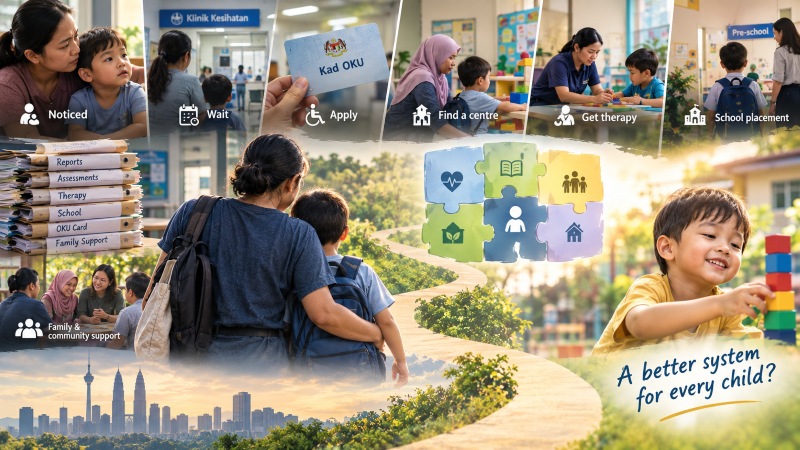
Consider the journey most families experience. The parents – at times, the nursery teacher or the nurse at the klinik kesihatan (health clinic) – notices some developmental delay in a child.
There is then the long wait for assessment with a specialist, often at a hospital.
The family is told to apply for a disability (OKU) card from the Department of Social Welfare.
They then search for a facility providing an early intervention programme. This might mean a community-based resource centre if they are rural, an NGO centre if they are urban, or a private centre if they can afford it.
- Sign up for Aliran's free daily email updates or weekly newsletters or both
- Make a one-off donation to Persatuan Aliran Kesedaran Negara (ALIRAN), Maybank a/c 507246118995 or CIMB a/c 8004240948
- Make a regular pledge or periodic auto-donation to Aliran
- Become an Aliran member
In the meantime, there is another long wait for a specific therapist (eg speech and language or occupational therapist), unless they can afford expensive private services.
When the child reaches pre-school age, the Ministry of Education does its own assessment and placement.
At every step, the family repeats its story, carries its own folder of reports and acts as the unpaid case manager (key worker) for a system that does not coordinate itself.
Quite often, what works is a family support group or a civil society organisation that supports the family through the whole process.
This is not new. An inter-ministerial committee on special education involving health, education and welfare was formed as far back as 1981.
More than four decades later, the burden of coordination still falls on parents, most often on mothers.
In 2018, the National Early Childhood Intervention Council (NECIC) wrote an open letter to the ministers of education, health and welfare outlining key gaps in services. Many of those gaps remain and some have widened.
If we want to move the public conversation forward, we need to ask some meaningful questions. Here are a few.
Accountability for national outcomes
There is no minister, ministry or department whose performance is measured by whether every child with a developmental delay is identified early and supported well. Each agency is accountable for its own programmes, not for the child.
Malaysia needs a designated lead agency for early childhood intervention, with a clear mandate and budget, supported by a national coordinating body that brings together health, education, welfare, rural development, state governments, NGOs, parents (care partners) and people with disabilities. This would ideally be the role of a children’s ministry.
Coordination
Is there a common referral protocol, a single assessment that all agencies accept, and a named key worker for each family?
Today the answer to most of these questions is no. Coordination should not depend on the goodwill of individual officers.
We need formal protocols: one shared family service plan per child, one key worker per family, consent-based information sharing, and joint planning at district level where services are actually delivered.
Is there a national pathway?
A parent should be able to know what happens from the moment a concern is raised: who to go to, how long they should wait, what support they can access, and what happens at transition to pre-school, formal schooling, and beyond.
Currently, no such nationally coordinated pathway exists.
Critically, support should begin when a concern is identified, not only after a formal diagnosis or registration of a person with disability.
Other countries (eg Portugal) have national early intervention systems jointly run by health, education and social security sectors, delivered in the child’s natural settings with parents as partners. It can be done.
Gaps in service provision
The gaps are well known to those of us who work on the ground.
- Geography and poverty: Services remain concentrated in urban areas and the Klang Valley. Rural communities, the interior of Sabah, Orang Asli families, the urban poor, and migrant, refugee and stateless children have little or no access.
- Quality of rural services: Community-based resource centres are often the only early intervention in rural Malaysia, yet many function as daycare rather than quality intervention.
- Children beyond autism: Children with other disabilities risk being left behind by an autism-centred policy response. Girls are also underdiagnosed.
- Inclusive education: The Malaysia Education Blueprint set a target of 75% of students with special needs in inclusive programmes by 2025. Have we achieved true inclusion or merely integration? Most current early childhood intervention initiatives are segregational?
- Workforce: Most early childhood intervention staff learn on the job. There is no national, recognised early intervention qualification and no plan to train transdisciplinary key workers at scale.
- Family support: Respite, caregiver psychosocial health and crisis support for older children with high support needs are largely absent.
Implications of unregulated services
In the vacuum left by the government has grown a largely unregulated sector.
Many NGOs have done good, low-cost work for decades, often surviving on donations and on underpaid, deeply committed staff.
Alongside them, there has been an unhealthy rise in commercially driven services that feed on parents’ fear for their children’s future and charge exorbitant sums with no requirement to publish fees or outcomes. Few have mandatory safeguarding policies.
We need registration of all early childhood intervention service providers against national standards, fee transparency, reasonable fee caps, mandatory safeguarding, an accessible complaints mechanism, and inspections.
Regulation must be supportive rather than punitive for non-commercial NGOs
Measures of success
At present, we count buildings, classes, allowances and registrations. These are inputs, not outcomes.
We should be measuring what matters to children and families, for example:
- Age at first concern and age at first intervention, and the gap between them (waiting time from referral to the start of support)
- The proportion of children identified with delay or disability who receive early intervention within three months
- Coverage by state and district, rural versus urban, and by household income
- The proportion of children with disabilities in inclusive pre-schools and kindergartens
- Number of mainstream pre-schools and schools supported to implement inclusion
- Out-of-pocket costs borne by families
- Do families know their rights and are they supported appropriately to help their child develop and learn?
- The number of trained early childhood intervention workers per child population
All data should be disaggregated by gender, type of disability, location and social class, so that we can see who is being left behind.
Access and inclusion scorecard
An annual early childhood intervention access and inclusion scorecard, prepared jointly by the ministries and reviewed independently by civil society and people with disabilities, would do much to drive change.
It would tell us, year by year and district by district, whether children are reaching support earlier, whether families are paying less, and whether inclusion is real.
Malaysia acceded to the Convention on the Rights of the Child in 1995 and ratified the Convention on the Rights of Persons with Disabilities in 2010. Transparent reporting is part of honouring those commitments.
The question we should be putting to our leaders is not “how many more centres will you build?” but “what kind of early childhood system are you building, who is responsible for it, and how will we know it is working?”
A good system would be government-led and funded, family-centred, inclusive by design, accountable for outcomes, and reach every child regardless of where they live, their family income or the label attached to them.
It is time we ‘make the right real’ for our children with disabilities. Our children cannot wait. – NECIC
- Dato’ Dr Amar-Singh HSS, advisor
- Wong Hui-Min, president
- Ng Lai-Thin, project lead
National Early Childhood Intervention Council (NECIC)
The views expressed in Aliran's media statements and the NGO statements we have endorsed reflect Aliran's official stand. Views and opinions expressed in other pieces published here do not necessarily reflect Aliran's official position.
- Tegakkan maruah serta kualiti kehidupan rakyat
- Galakkan pembangunan saksama, lestari serta tangani krisis alam sekitar
- Raikan kerencaman dan keterangkuman
- Selamatkan demokrasi dan angkatkan keluhuran undang-undang
- Lawan rasuah dan kronisme
