

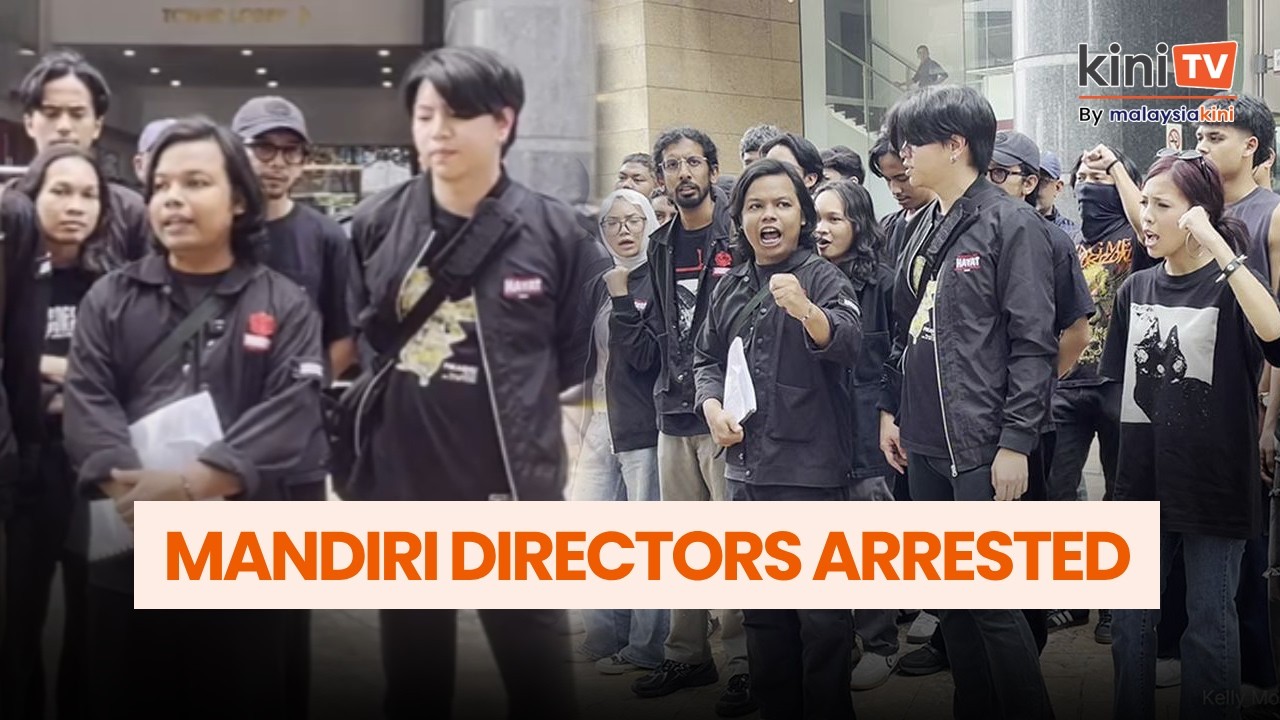
It has been reported that human rights defenders and their organisations are now falling victim to unjust ‘account freezing’ laws.
The bank accounts of Mandiri, Hayat, Dobby Chew and Amir Hariri Abd Hadi have been frozen. Previous reported victims of this same law include GISBH (Global Ikhwan Services and Business Holdings Sdn Bhd).
It was also just reported: NGOs Mandiri and Hayat said nearly 20 officers from the anti-money laundering unit raided their new shared office to seize organisational documents.
The state crackdown on these human rights defender organisations and defenders is a matter of great concern.
Abolish law allowing officers to freeze accounts
The freezing of bank accounts of people and entities under section 44(1) of the Anti-Money Laundering, Anti-Terrorism Financing and Proceeds of Unlawful Activities Act 2001 (Amla) is based simply on the orders of an officer of enforcement agencies. There is no court order.
Further, section 44A (Variation or revocation of order to freeze property) provides that the order can be varied and even revoked, including on the application of victims, by “an officer senior in rank to the officer who issued the order”.
This is absurd. The provision can also be used to deny speedy access to courts, because all appeal processes provided by law must generally be complied with first. Only after complying with the procedures in the act can victims access the courts.
- Sign up for Aliran's free daily email updates or weekly newsletters or both
- Make a one-off donation to Persatuan Aliran Kesedaran Negara (ALIRAN), Maybank a/c 507246118995 or CIMB a/c 8004240948
- Make a regular pledge or periodic auto-donation to Aliran
- Become an Aliran member
Enforcement agencies generally investigate and secure evidence.
It is usually the public prosecutor who checks and evaluates the evidence to determine whether it is sufficient to prove guilt. Only then can the accused be charged in court. The public prosecutor also verifies and approves other actions, such as compound offers.
Then, after a fair trial, it is the courts and judges who determine whether the prosecution has managed to prove guilt beyond a reasonable doubt. That leads to conviction and an appropriate sentence.
Amla therefore contradicts the norm, because a mere officer of an enforcement agency is empowered to issue an order freezing bank accounts and seizing property. Even the prosecution does not come into the picture to verify and confirm that such an order can be made.
This power should never be given to any officer of an enforcement agency or investigation body.
It should rightly lie with the courts, which would determine that all required conditions are satisfied before ordering a freeze or seizure at this early stage because the alleged victim has not yet been charged or, more importantly, found guilty after a fair trial. In this case, the human rights defenders have not even been called in for investigation.
Is there a rationale for the law?
The object of bank account freezing laws is presumably to prevent the fruits of crime, or ‘dirty money’, from being dissipated or sent out of the country before the trial is over. If this happens, it becomes almost impossible to recover. This happened in the case of former Prime Minister Najib Razak, when about RM2bn in Najib’s account was sent out of Malaysia.
The primary concern, then, is to prevent dissipation beyond the jurisdiction of the Malaysian courts, which makes recovery difficult.
In Najib’s case, the courts only confirmed that the money was ‘fruits of a crime’ when the High Court found him guilty on 26 December 2025. He was sentenced to 15 years in jail and fined RM13.4bn after being found guilty of all counts of abuse of power and 21 money-laundering charges involving RM2.3bn in 1MDB funds.
So there is a rationale for preventing ‘dirty money’ from moving out of the jurisdiction of the Malaysian courts. But it can also invite a gross miscarriage of justice if the victims are ultimately found not guilty.
Do we need a law that prevents the dissipation of such money or property from Malaysia, rather than freezing entire accounts?
The decision to freeze accounts should never rest on an ordinary officer of an enforcement agency. It must be decided by the courts, which should also allow victims the right to be heard.
Care must be taken not to freeze money in a way that will affect or ‘kill’ a business, organisation or an individual’s wellbeing, given the presumption of innocence until proven guilty in court.
Court orders should be required
Court orders are needed for arrest and search. They should also be required for freezing bank accounts.
Even for arrests and searches in Malaysia, the courts step in to prevent abuse by requiring a warrant. This is a needed check and balance.
The magistrate or judge judiciously considers whether the legal requirements for an arrest or search warrant are satisfied before issuing one. If not, no warrant is issued. Likewise, a magistrate’s remand order is needed for detention beyond 24 hours.
It should be the same for orders to freeze accounts or seize property under the Amla.
Judges would decide judiciously whether to issue such orders. This is very important because of the serious implications of these pre-charge and pre-conviction orders. They may effectively ‘kill’ organisations, businesses and entities, and cause serious, irreparable harm and injustice to individuals.
It is shocking that human rights defenders personally, and human rights organisations in Malaysia, have now fallen prey to these draconian provisions. They include section 44(1) of Amla and other bad provisions in Part VI (Freezing, Seizure and Forfeiture).
Defenders and groups under freeze
It was reported that the personal bank accounts of human rights defenders Chew and Amir Hariri, and the accounts of human rights groups Hayat and MandiriI, have been frozen.
Mandiri is a youth-led civil society organisation founded in 2024 to empower young people and strengthen democratic participation in Malaysia.
Hayat is a human rights and advocacy organisation focused on criminal justice reform, decarceration, restorative justice and the abolition of the death penalty.
Pre-conviction freezing orders can kill businesses
We recall that in 2024 the police froze a total of 206 accounts linked to GISBH, valued at more than RM1.4m to date. According to Malay Mail (3 October 2024), the freezing of accounts and assets related to GISBH was also carried out under Section 44(1) of Amla.
In the GISBH case, there has been no report that guilt has been proven in court after a fair trial, which would validate the freezing of these accounts and the seizure of property.
We are also aware of the impact on businesses allegedly linked to GISBH. In many towns across Malaysia, these businesses have already closed, even though proof of guilt after a fair trial is yet to be established.
Even if it is eventually determined that they are not guilty, the freezing of accounts and seizure of property may never be undone. Businesses may be killed. Individuals may even lose homes or cars because accounts were frozen and there was no money to settle loan obligations.
Impact on businesses, groups and individuals
Freezing the bank accounts of organisations or businesses can literally ‘kill’ them. Workers’ wages cannot be paid, rent and utility bills cannot be settled, and normal operations cannot continue without money.
When an individual’s account is frozen, that person is at risk of losing homes, cars and other property because loan obligations cannot be settled.
The power to freeze accounts and seize property prematurely is most draconian when it happens before the ‘suspects’ are charged in court. Gross injustice results when the suspects are never charged, or are charged and then found not guilty.
Section 44(6) of the law states that “an enforcement agency shall not be liable for any damages or cost arising directly or indirectly from the making of an order under this section unless it can be proved that the order under subsection (1) was not made in good faith…”
This means the victim has the onerous task of proving ‘lack of good faith’. Shouldn’t a wrongful freeze, proven at trial, not be enough for the victim to receive just compensation and damages from the government?
In the recent case involving the human rights defenders and their organisations, it was reported that they were not even being investigated when their accounts were frozen: “Not once have we been contacted regarding this block. We have also never been summoned for any investigation.”
Now, groups of human rights defenders may be ‘killed’ before their guilt is proven in court. That is not acceptable.
Prime Minister Anwar Ibrahim and the government must protect human rights defenders and ensure these organisations are not subdued.
Why court orders are needed
Section 44(1) states:
…an enforcement agency may issue an order to freeze any property of any person, any terrorist property or proliferator property, as the case may be, wherever the property may be, and whether the property is in his possession, under his control or due from any source to him, if –
(a) an investigation with regard to an unlawful activity has commenced against that person; and
(b) either –
(i) the enforcement agency has reasonable grounds to suspect that an offence under subsection 4(1) or 4A(2), a terrorism financing offence or a restricted activity financing offence has been or is being or is about to be committed by that person; or
(ii) the enforcement agency has reasonable grounds to suspect that the property is the proceeds of an unlawful activity or the instrumentalities of an offence.
Before any freezing order, then, an investigation must already have begun.
Most importantly, there must be reasonable grounds to suspect that the offence has been committed or is about to be committed, or that the property to be frozen or seized is the fruit of crime.
It is only just and reasonable that the courts determine whether there are reasonable grounds to suspect, and whether the relevant conditions are met, before orders are made.
There must be sufficient evidence to prove reasonable grounds to the courts – not mere suspicion but reasonable suspicion.
The law that now empowers officers who are investigating the crime to issue freezing orders must be abolished.
In the recent case, the human rights defenders and their organisations were kept in the dark. “Not once have we been contacted regarding this block. We have also never been summoned for any investigation.”
So has an investigation even begun when the victims are yet to be called in? What is the crime being investigated?
Freezing orders issued at this stage, before guilt is proven after a fair trial, should not affect the running of a business or an organisation’s activities. They must also take into account money needed by individuals to continue their lives normally.
This is crucial, as guilt has yet to be established and we must be true to the legal principle of presumption of innocence.
The amended law could allow the enforcement agency or prosecution to obtain an ex parte (one-sided) order speedily. Victims should then have the right to challenge or vary the order at an inter partes (both sides) hearing soon after, usually within 14 days.
Are politicians’ allegations behind this?
Why have the accounts been frozen in these cases? Is it connected to what PKR’s youth wing chief Kamil Munim, of Anwar’s party, allegedly claimed? Kamil allegedly claimed in May that funds were connected to political movements, including the financing of social media operations and the mobilisation of street protests aimed at creating anti-government sentiment under the guise of democracy and human rights.
There is no clear report indicating what exactly prompted the freezing orders against these defenders.
In Malaysia, organisations like Hayat and Mandiri may be receiving foreign funding, but this is usually reported to the authorities as required by law. Are they receiving money from organisations that they are specifically prohibited from receiving money from?
Or is this action by the state a mere reaction to human rights groups that have been critical of the government led by Anwar on human rights and justice issues?
Malaysians Against Death Penalty and Torture (Madpet) calls for the repeal of section 44(1) of Amla. It now allows an officer of the enforcement agency alone, with no court order, to issue an order on its own to freeze any property of any person. Those affected receive no prior notice or right to be heard.
Alternatively, Madpet calls for an amendment of section 44(1) requiring a court order before bank accounts are frozen or property is seized. Victims would have the right to be heard at inter partes hearings, which should happen fast – within 14 days or less.
Just as magistrates’ orders are needed for remand beyond 24 hours, and warrants are required for arrests and searches, the judiciary plays an important role in preventing abuse and mistakes by law enforcement agencies.
Madpet therefore calls for a court order before accounts are frozen or property is seized.
Madpet also calls for freezing never to affect the ordinary running of an organisation or business. It would be a gross injustice, more so because these are pre-conviction orders and the courts may eventually find that no crime was committed.
It is wrong for workers to lose wages and jobs, and for other irreversible consequences to follow such orders. In the case of these groups and individuals, this has happened before they have even been charged in court.
If the allegations concern funds from certain entities, only those funds should be affected by any freezing order. It should not affect all funds, including those from other sources and sometimes from the Malaysian public.
Malaysia must acknowledge human rights defenders and their organisations, who are also recognised by the UN Declaration on Human Rights Defenders. The declaration was adopted by consensus by states, including leaders who do or say things that violate human rights.
It is folly for Prime Minister Anwar and the government to expect that human rights defenders will always ‘blindly’ support the government. They will voice out and highlight human rights violations, and even take part in peaceful assemblies and other actions.
Madpet also calls on the government to end ‘attacks’ on human rights defenders. It asks the government to provide specific details about the alleged crimes committed by Hayat, Mandiri and the affected defenders. – Madpet
The views expressed in Aliran's media statements and the NGO statements we have endorsed reflect Aliran's official stand. Views and opinions expressed in other pieces published here do not necessarily reflect Aliran's official position.
- Tegakkan maruah serta kualiti kehidupan rakyat
- Galakkan pembangunan saksama, lestari serta tangani krisis alam sekitar
- Raikan kerencaman dan keterangkuman
- Selamatkan demokrasi dan angkatkan keluhuran undang-undang
- Lawan rasuah dan kronisme
