

Mohideen Abdul Kader
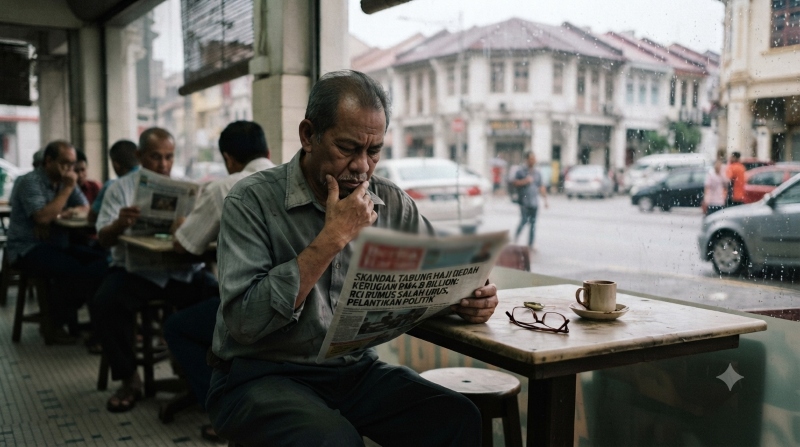
The long-awaited declassification of the Royal Commission of Inquiry report on Lembaga Tabung Haji has confirmed what millions of depositors feared most: a catastrophic breakdown of governance, driven by rampant political interference and fiscal deception.
For decades, Tabung Haji was viewed as a sacrosanct institution – a beacon of Islamic financial management built on the blood, sweat and life savings of everyday ordinary people striving to fulfil their religious duty of performing the Hajj.
To find that this sacred pilgrim fund was manipulated as a political playground and subjected to reckless “creative accounting” is not merely an institutional failure. It is a profound moral betrayal and an indelible blemish on the reputation of Islamic governance in Malaysia.
Shattered international reputation
Beyond our borders, Tabung Haji was long celebrated across the Muslim world as a gold standard in Islamic social finance and pilgrimage management.
Delegations from across Africa, West Asia and the rest of Asia routinely travelled to Malaysia to replicate its innovative model.
The findings of the royal commission report completely tear down that international stature. By demonstrating that one of the pioneer institutions of the global Islamic economy was plagued by systematic fraud and political manipulation, this scandal inflicts severe reputational damage on Malaysia’s standing as a global leader in Islamic finance and development.
- Sign up for Aliran's free daily email updates or weekly newsletters or both
- Make a one-off donation to Persatuan Aliran Kesedaran Negara (ALIRAN), Maybank a/c 507246118995 or CIMB a/c 8004240948
- Make a regular pledge or periodic auto-donation to Aliran
- Become an Aliran member
How can Malaysia preach ethical, Sharia-compliant financial standards abroad when our flagship Islamic institution was corrupted at home?
Erosion of faith in religious institutions
Even more damaging is the profound erosion of public trust in religious authorities. When sacred institutions established under the banner of Islam are exposed for self-serving misconduct, it breeds deep cynicism among the public.
It weaponises faith for political ends and casts doubt on the integrity of religious leadership as a whole.
Depositors did not just lose faith in a financial fund; they felt spiritually betrayed by those who swore to uphold Islamic principles of stewardship (amanah) and justice (‘adl).
Calculated deception
The mechanics of this betrayal, outlined in the royal commission report, are appalling.
In 2017 alone, while Tabung Haji declared a glowing profit of RM3.4bn, proper financial reporting standards reveal it was actually suffering a net loss of RM1.4bn – a staggering RM4.8bn gap masked through manipulated asset valuations and ignored impairment losses.
Operating under an asset-liability deficit as far back as 2014, Tabung Haji nevertheless continued to pay out unearned profit distributions (hibah) beyond its capacity.
This was not a victimless accounting trick. Paying out unearned returns systematically eroded depositors’ underlying capital.
To add insult to injury, excessive bonuses were disbursed to executives and board members during periods of severe financial distress.
Unchecked political interference
The royal commission explicitly identifies political involvement as the core driver of these abuses. The government and political stewards of that era treated a public trust fund as political ammunition.
Crucial decisions – ranging from hibah distribution rates to investment strategies – were dictated not by financial prudence or Islamic ethics, but by short-term political expediency and survival.
When politicians and political appointees are granted unchecked authority over public and religious funds, ethical standards vanish, accountability disappears, and millions of ordinary consumers pay the price.
No immunity, no compromise
The Consumers Association of Penang (CAP) demands that this royal commission report must not be allowed to gather dust.
The public demands full accountability:
- Unsparing criminal prosecution: The Attorney General’s Chambers and the Malaysian Anti-Corruption Commission (MACC) must act swiftly and decisively. Every individual – regardless of political stature, past ministerial status or executive rank – who engaged in abuse of power, financial misrepresentation or breach of trust must face the full force of the law.
- Comprehensive governance overhaul: The Tabung Haji Act 1995 must be immediately amended to strip away sweeping ministerial powers and permanently bar active politicians from holding board or executive positions.
- Independent financial oversight: Investment operations must be subjected to strict regulatory standards under the Securities Commission and Bank Negara to restore institutional integrity.
Malaysian consumers and depositors entrusted their sacred savings to an institution meant to serve God and the ummah.
Those who exploited that trust for personal and political gain must answer for their actions – both in the courts of law and before the nation. – CAP
Mohideen Abdul Kader is the president of the Consumers’ Association of Penang (CAP).
The views expressed in Aliran's media statements and the NGO statements we have endorsed reflect Aliran's official stand. Views and opinions expressed in other pieces published here do not necessarily reflect Aliran's official position.
- Tegakkan maruah serta kualiti kehidupan rakyat
- Galakkan pembangunan saksama, lestari serta tangani krisis alam sekitar
- Raikan kerencaman dan keterangkuman
- Selamatkan demokrasi dan angkatkan keluhuran undang-undang
- Lawan rasuah dan kronisme

All very concerned and active giving the impression that they were not aware what was going on all these decades?
All may be forgotten after a few days. WAIT and SEE.
Bless all