

This is the season when the nation celebrates independence and then Malaysia Day on 16 September.
As usual, leaders are giving speeches and political parties are holding hold activities that promote patriotism.
Mainstream politicians will make the usual statements about the importance of unity among all communities, saying it is vital for political stability – and, in turn, economic progress.
But the unity that Malaysia’s elites usually talk about is different. It gives them a free hand to do what they see fit for the country, instead of addressing the real aspirations of grassroots communities.
Malaysia has come a long way in building a kind of equilibrium in society, with relative peace and harmony among multi-ethnic communities at the grassroots level.
But there could be greater benefits if people shared a common destiny that transcends ethnicity and religion.
It is a pity that this common destiny is rarely the focus of ethno-centric politicians, who remain preoccupied with the divisive politics of race and religion that drives mainstream politics in the country.
- Sign up for Aliran's free daily email updates or weekly newsletters or both
- Make a one-off donation to Persatuan Aliran Kesedaran Negara (ALIRAN), Maybank a/c 507246118995 or CIMB a/c 8004240948
- Make a regular pledge or periodic auto-donation to Aliran
- Become an Aliran member
What is obvious is this: after over six decades since Malaysia’s formation, the political and corporate elites still dictate Malaysia’s path. They do so by dwelling on the polarising lines of ethnicity and religion, capital and labour, the elite and the ordinary people, the haves and the have-nots.
We have not yet achieved a truly egalitarian society – one where there is little distance between the elite and ordinary people.
The media is full of political statements and counter-statements, with less attention on what happens among multi-ethnic grassroots communities.
These communities face common challenges: poor drainage, flooding, poverty, inflation, and a lack of power to shape their own neighbourhoods and cities. Power remains concentrated in the hands of elites.
It is in this context of shared challenges that multi-ethnic Malaysia can find real solidarity – not merely unity drawn along ethno-centric lines.
Grassroots work and solidarity among all ethnic communities matter. They call for a local government that meets the people’s real needs.
Malaysia needs prime ministerial and ministerial candidates at the federal level who have experience of local government.
Several countries have achieved remarkable economic success by giving local governments high fiscal autonomy, legislative power and development mandates.
Rather than relying strictly on top-down directives from a central capital, these nations let local authorities act as entrepreneurial drivers of growth. Germany and Switzerland are examples of successful local government systems.
Even authoritarian countries like China are decentralised. Beijing promotes local officials mainly based on how fast they grow their local gross domestic product (GDP), and how much socioeconomic progress they bring to their communities.
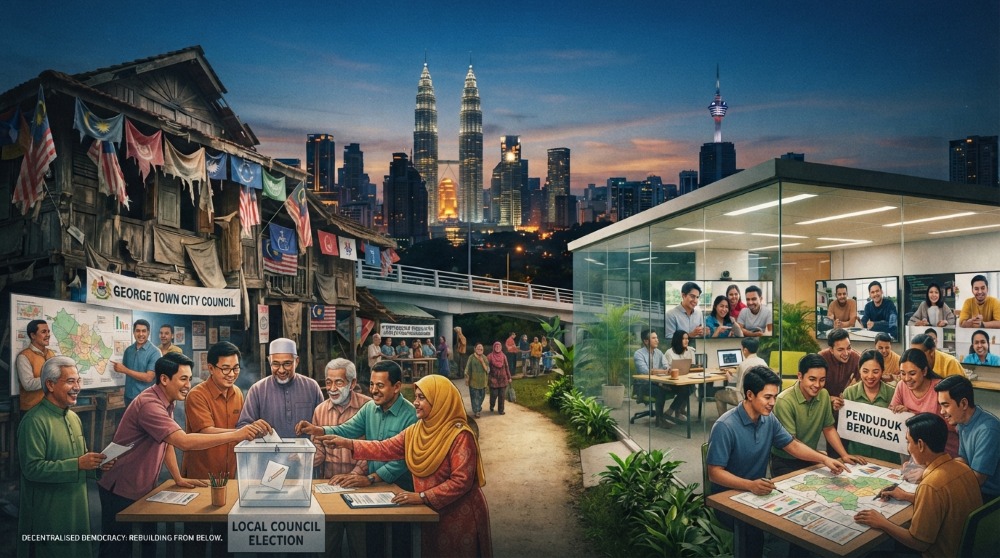
As Malaysia Day celebrations approach, the people should reflect on the importance of grassroots democracy and local government elections.
These could help build Malaysia from the bottom up – a democracy that reflects authentic independence, rather than one driven by the agendas of elite ethno-religious political parties.
The views expressed in Aliran's media statements and the NGO statements we have endorsed reflect Aliran's official stand. Views and opinions expressed in other pieces published here do not necessarily reflect Aliran's official position.
- Tegakkan maruah serta kualiti kehidupan rakyat
- Galakkan pembangunan saksama, lestari serta tangani krisis alam sekitar
- Raikan kerencaman dan keterangkuman
- Selamatkan demokrasi dan angkatkan keluhuran undang-undang
- Lawan rasuah dan kronisme
