

James Bayu
The scale of the burning is staggering. Cumulatively, from January till end-July this year, an estimated 202,000 hectares of forest and land burned in Indonesia – nearly three times the size of Singapore.
The scale of the fires
Unofficial estimates are far higher. Independent Indonesian forest monitoring platform Nusantara Atlas suggests that “around 895,657 ha of land across the country had been burnt between January and the end of August”.
Daily official reports paint a similar picture: “Across 47 reported days the all-confidence series totals 178,718 detection-days: Kalimantan 55.8 percent, Sumatera 7.8, Papua 6.4, Bali, Nusa Tenggara and Maluku 3.2, Jawa 1.1, Sulawesi 0.6, unallocated 25.2. The strongest day was August 22 at 13,591; the high-confidence peak was 1,153 on August 25, 9.0 percent of that day’s total.”
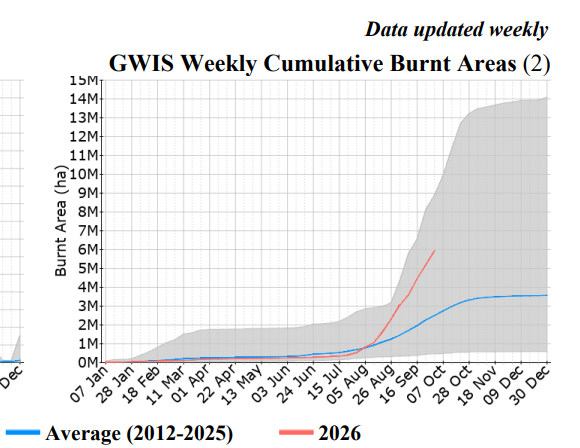
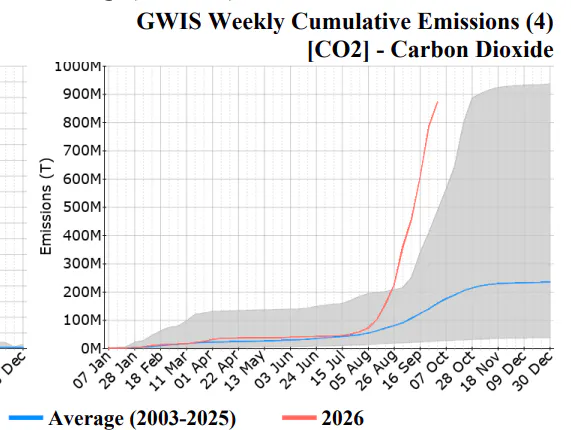
Data from the Copernicus Global Wildfire Information System (GWIS) estimates that “across Indonesia, roughly 6,320,690 hectares have burned so far in 2026 – 77% above the two-decade average”. Nearly 900 million tonnes of carbon dioxide (CO2) were released into the atmosphere (see Charts 1A & 1B: GWIS Indonesia datasheet, 7 October 2026).
PM2.5 emissions from the wildfires in Indonesia from January to September 2026 were estimated at about 4.2 million tonnes. These particles, less than 2.5 micrometres in diameter, are extremely toxic to people and wildlife.
Charts 1A & 1B: Indonesia GWIS weekly cumulative burnt areas and weekly CO2 cumulative emissions
- Sign up for Aliran's free daily email updates or weekly newsletters or both
- Make a one-off donation to Persatuan Aliran Kesedaran Negara (ALIRAN), Maybank a/c 507246118995 or CIMB a/c 8004240948
- Make a regular pledge or periodic auto-donation to Aliran
- Become an Aliran member
Source: Copernicus GWIS
El Niño or man-made?
As in every haze year since the 1980s, the hapless people of Sarawak asked each other: “Who is responsible for starting these fires? Who is responsible to prevent these fires? Is there no policy implementation and enforcement to control these fires? Whatever happened to Asean and its Transboundary Haze Treaty? Why isn’t our national government pushing the Indonesians to stop the fires?”
They also asked: “Which Malaysian oil palm and wood pulp companies are complicit in these illegal burnings? And why do we have to breathe these noxious toxins every year while big oil palm and wood pulp companies and their downstream buyers, processors, traders, manufacturers, financiers and investors continue to rake in profits by the billions?”
Most media and corporate bigwigs – mainly from the oil palm plantation industry – quickly linked the fires to the extra-hot and extra-dry climate generated by the ‘Super El Nino’ phenomenon. Others blamed the slash-and-burn land clearing practices of traditional Indigenous swidden farmers. It looked like the usual devious diversionary tactics by the palm oil industry and the cowed Malaysian media.
Additionally, given the inordinate influence of the oil palm and palm oil industry lobby in Malaysia, no politician, government policymaker or civil servant in Putrajaya wanting to remain in their paygrade even bothered to notice let alone comment on the choking haze obfuscating their swanky air-conditioned office views.
Our globetrotting Prime Minister Anwar Ibrahim preferred to serenade Narendra Modi with his rendition of Khwab Ho Tum Ya Koi Haqeeqat (Are you a dream or are you reality?) at a gala dinner during the 18th Brics summit in Delhi in mid-September. Disappointingly, while PM Anwar may have been karaoke-ing and dining at a dream dinner, the residents of Sarawak were at that time choking badly with the awful reality of thick haze!
In fact, Anwar only reportedly contacted President Prabowo Subianto on 8 October to “discuss measures in tackling haze caused by forest and land fires in Kalimantan and elsewhere” when the haze breached unhealthy levels in Putrajaya and many other parts of West Malaysia.
Natural occurrences?
Are these peatland forest fires natural occurrences? The historical reality is that there is a clear overlap of oil palm plantation and smallholder expansion in Indonesia since the late 1980s with the rising incidence of forest fires and haze.
That expansion was mainly fuelled by Malaysian mega-plantation groups and Indonesian state-owned companies. In other words, the oil palm plantations and smallholders are central contributors to the persistent annual forest fires in Indonesia.
The irony is that both Indonesia and Malaysia are, given their equatorial monsoon climates, naturally fire-resistant landscapes.
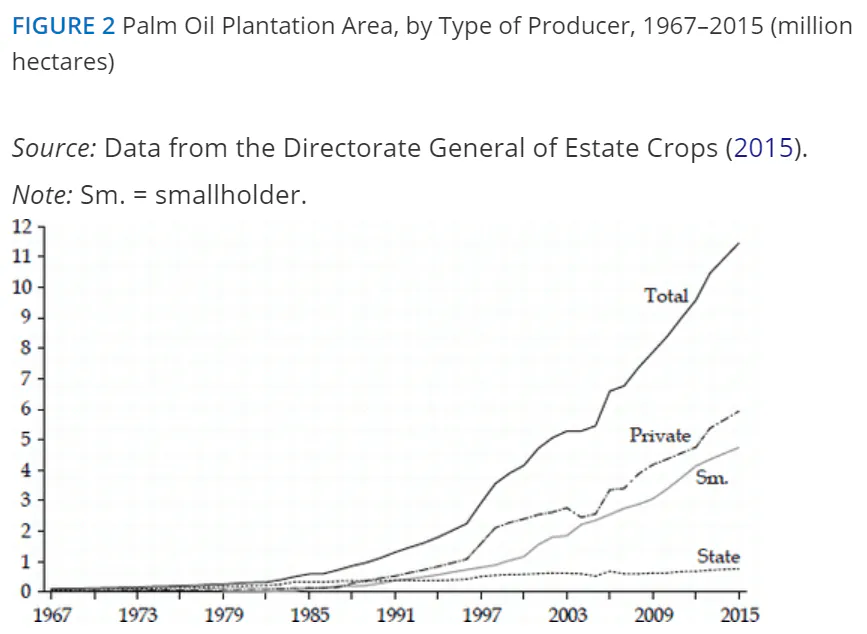
A 2017 journal article by Pramudya, Hospes and Termeer shows how oil palm plantations and smallholdings exploded over Indonesia from 1967 till 2015 (see Chart 2 below).
Chart 2: Oil palm plantation area, by type of producer, 1967-2015 (million hectares)
Source: Pramudya, EP, Hospes, O and Termeer, CJAM (2017) ‘Governing the Palm-Oil Sector through Finance: The Changing Roles of the Indonesian State’, Bulletin of Indonesian Economic Studies, 53(1), pp 57-82
Note the sharp jump in oil palm plantation area from the late 1980s to 2015. By 2024 land under monocrop oil palm cultivation had reached 16.0 million hectares; mostly in Kalimantan and Sumatra (BPS Statistics Indonesia, 2025, p5).
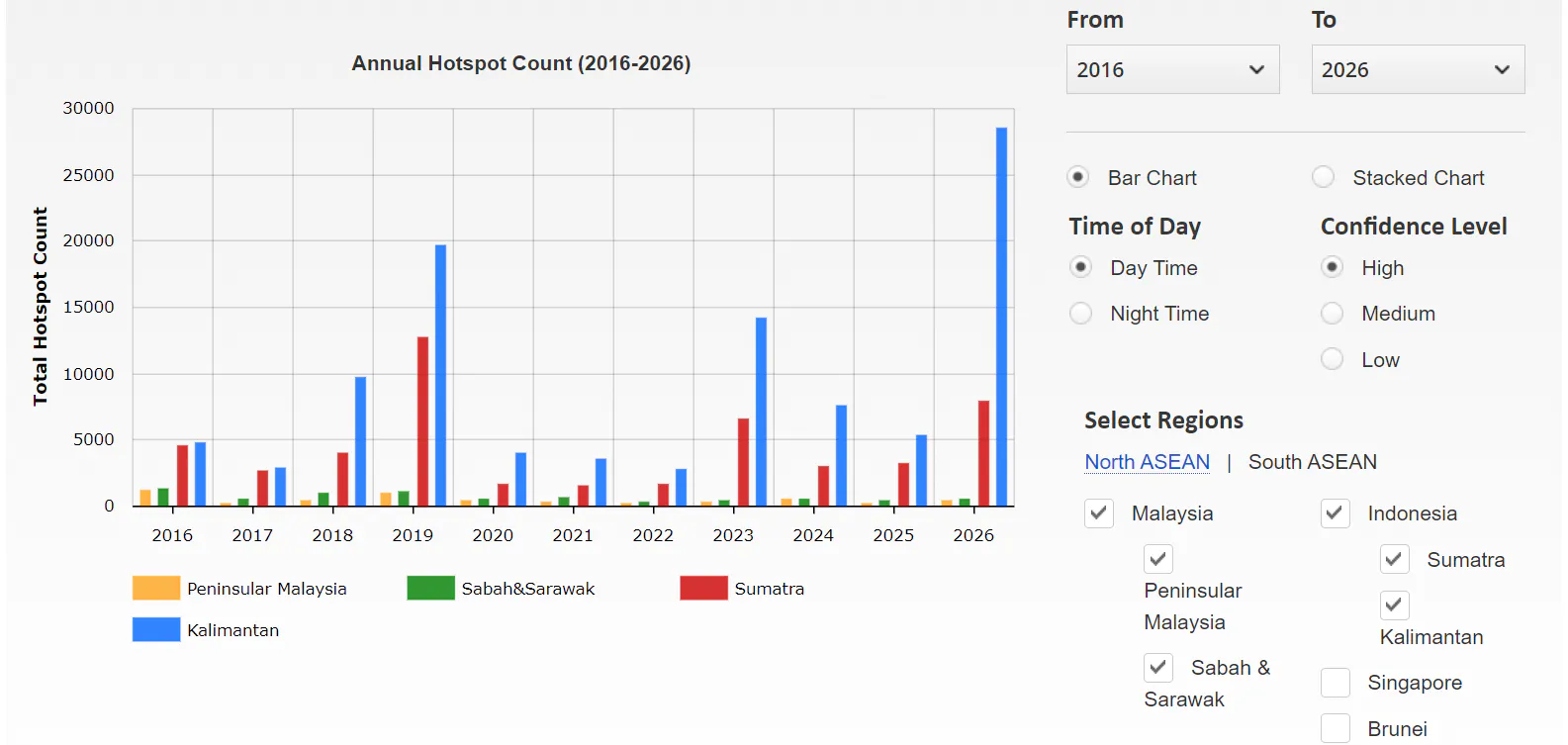
Now compare this explosive growth of oil palm monoculture with the cumulative hotspot fires in Indonesia from 2016 to 2026: it indicates that fire is a major cause of forest clearances in Sumatra and Kalimantan. This data is even more stark when juxtaposed against hotspot fires that occur in Peninsular Malaysia, Sabah and Sarawak.
After all, if El Nino is to be blamed for the fires in 2026, surely the dry weather would also affect the peninsula, Sabah and Sarawak! Wouldn’t we expect to see a similar trend of hotspot fires? But we do not. The satellite hotspot data shows otherwise (see Chart 3).
Chart 3: Annual hotspot count (2016-26), maritime Southeast Asia
Source: Asean Specialised Meteorological Centre, Transboundary Haze Hotspot Information
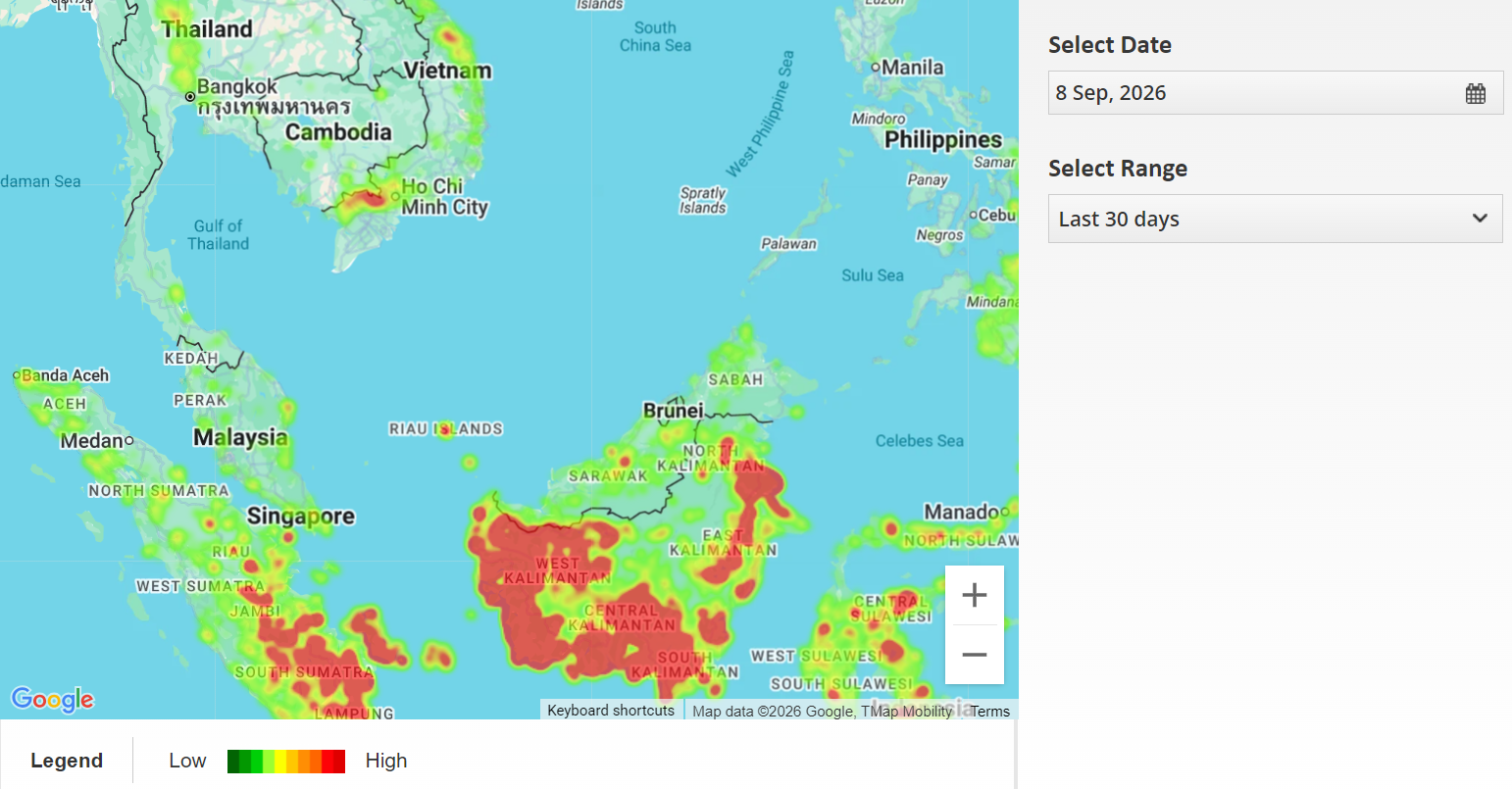
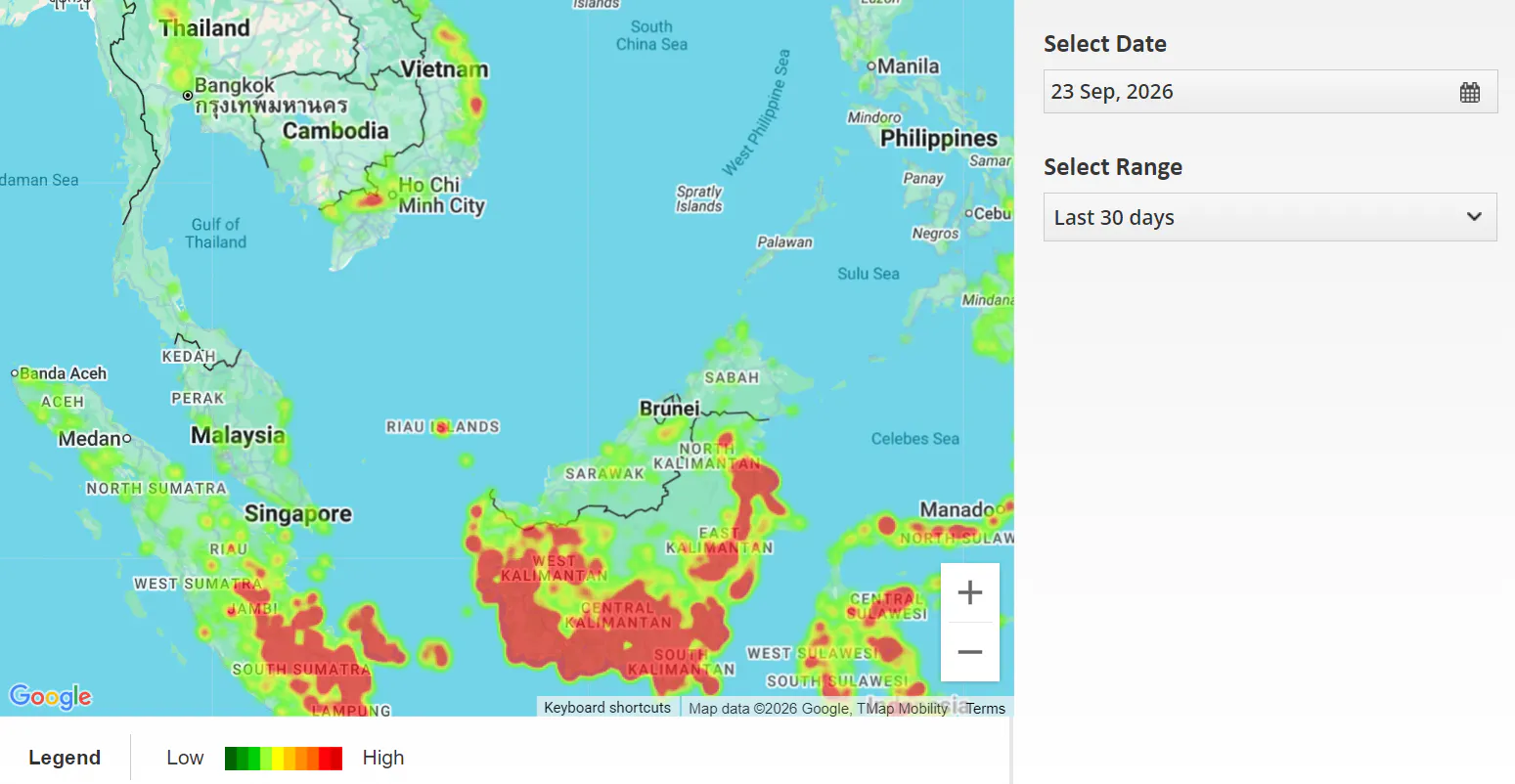
Hotspot density distribution maps from mid- and end-September 2026 are also self-evident (see Maps 1 and 2). They clearly show fires in Kalimantan, Sumatra and Sulawesi, and relatively few in Malaysia.
Map 1: Hotspot density map, Southeast Asia, 8 September 2026
Source: Asean Specialised Meteorological Centre, Transboundary hotspot density map
Map 2: Hotspot density map, Southeast Asia, 23 September 2026
Source: Asean Specialised Meteorological Centre, Transboundary hotspot density map
Two countries, two responses
The Malaysian fires occurred mainly in Sarawak and Johor. The Natural Resources and Environmental Sustainability Minister Arthur Joseph Kurup admitted in Parliament in early October that a “total of 1,447 open burning cases were recorded in less than two months, particularly in Sarawak”. Between 3 August and 29 September, the Department of Environment and other agencies took 2,132 enforcement actions, issued 41 notices, 27 compounds (fines). Fourteen large fires were fully extinguished.
So the corporate and government arguments that these wildfires were naturally occurring due to the Super El Nino phenomenon is utter rubbish! While the dry weather may have made the fires worse, the fact is they were mainly man-made and for the purpose of clearing forests cheaply. Both Malaysia and Indonesia saw fires that produced the poisonous haze.
But there was a big difference in how the two governments managed and contained the fires.
The fires in Malaysia were quickly extinguished and not left to linger like they did in Indonesia. This indicated that Malaysia’s anti-forest fire laws, policy enforcement and Malaysian Sustainable Palm Oil Standards (MSPO) are far more effective than Indonesia’s.
In June, Indonesian government officials acknowledged that the forest fires had been burning in various parts of the huge archipelago since January 2026. And yet, nine months later in October, they continued to burn with “1,201 high-confidence hotspots”.
Only after the fires and haze had blanketed Indonesia and most of Southeast Asia for months did officials begin emphasising prevention. Forestry Minister Raja Juli Antoni announced on 24 September that President Prabowo Subianto would establish a new agency, the National Peatland and Mangrove Management Agency, to prevent forest and land fires.
Yet, one can’t help but be cynical about such glib political announcements. There have been similar statements of intent in Indonesia (and Malaysia) over the last three decades with little follow through.
Parts 3, the final part, to follow
James Bayu is the pseudonym of an analyst who is deeply concerned about the recurring haze blanketing the region.
The views expressed in Aliran's media statements and the NGO statements we have endorsed reflect Aliran's official stand. Views and opinions expressed in other pieces published here do not necessarily reflect Aliran's official position.
- Tegakkan maruah serta kualiti kehidupan rakyat
- Galakkan pembangunan saksama, lestari serta tangani krisis alam sekitar
- Raikan kerencaman dan keterangkuman
- Selamatkan demokrasi dan angkatkan keluhuran undang-undang
- Lawan rasuah dan kronisme
