
|
|||||||||||||||
|
HEART TO HEART
7 July: Islam and the problem of ‘British values’ Legitimate rejection of religious irrationalism need not become a campaign against Islamic and other faith-based systems.
by John Hilley
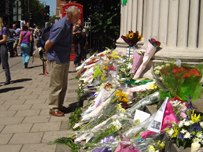
Islam in the dock As Muslim leaders contemplate the social fallout, measured grieving for the victims has been transformed into a nationally appropriated event, another “Diana moment”. Just as Blair and the media helped shape that drama, so have they used the London bombings to contrive a “mood occasion” of public shock and mock unity. The “shock” lies in the apparent disbelief that anyone who is British, home born or naturalised, could bring themselves to carry out such an act. There is, we are told, “incomprehension” that, having been granted the economic and cultural benefits of British society, such people could turn on those supposed gifts and values. As Tony Blair said in the House of Commons: “It is a form of terrorism aimed at our way of life.” Beyond its soundbite intent, this message carries a significant subtext: that such people are not only misguided fanatics, but cultural deviants. Interwoven here is a subtle injunction to the Muslim community: we welcome and applaud your common condemnation of this atrocity, but you must also look inwards and accept your responsibility for harbouring this criminal cult. We, of course, who have trampled all over the Muslim world, and elsewhere, in the name of freedom and democracy, have nothing to answer for. And with this comes the core essence of the message: you are British and here, but you are still, in your value system, elsewhere, and, thus, not fully of us, not truly part of our way of life. Islam on the couch Struggling to grasp this anomaly, the news media are now eagerly probing the mind of the suicide bomber. Having long ignored why young Palestinians undertake this greatest sacrifice, soundbite psychologists have been enlisted to ponder the dark motivations of these “disturbed individuals”. Seemingly absent from their assessment is the possibility that these “crazed jihadis” might have been able to think independently about the injustices of British and US foreign policy. And with this, other possibilities must remain dormant: that comfortable British Muslims might actually feel affinity for persecuted people, Muslims and non-Muslims, in other countries; that their regard for brutalised Palestinians and Iraqis may be more immediate than being British; that having harboured such feelings, young fertile minds might move towards the next “logical” stage of violent retribution. By all accounts, these young men, guided through madrassas in Pakistan and training camps in Afghanistan, have made that fatal leap. Questions remain as to whether they died as martyrs or as dupes. Whatever the case, they, and those responsible for their direction, will have to answer to their God for their terrible actions. Yet we must also ask what are the tipping points that push such people to the edge. The answers are not hard to find. In Iraq, prior to the invasion, there were no suicide bombings. Now they are a daily, desperate feature of life. As an occupying force in that country, Britain has now become part of that frontline. Add Palestine, Afghanistan, Chechnya and other oppressions to that list and we begin to see why the line is now truly global. Pulling together “We will not let them win”; “Islamic terror is a scourge to be defeated, irrespective of Iraq”. As consummate showman, Blair has used the moment to expedient effect. Sweeping new powers are now promised, including deportation of religious dissidents and closure of seditious mosques. “The rules of the game are changing,” Blair insists, dismissing legal concerns about a proposed amendment to the Human Rights Act. Despite the execution of an innocent Brazilian man, the police, now acting on a shoot-to-kill directive, seem ready to take out anyone with a dark face. “Pulling together”, Blair has also met British Muslim leaders to ask why young Muslim men are resorting to violence. One can only marvel at his charming effrontery. But, as with the growing turn against Bush’s 9/11 rhetoric, sham consultations and the “Blitz spirit” cannot stem the growing evidence of deceit over Iraq, nor the sobering reality of Islamic bombers in British cities. In the week following the 7 July attacks, a key study by research institute Chatham House showed a conclusive link between Britain’s occupation and the likelihood of more terror on home soil. In the same week, a Guardian poll showed that only 28 per cent of people in Britain believe Blair’s mantra that there is no connection between Iraq and the bombings. Arousing hatred and calls to war Meanwhile, on trains and buses, Asian and Middle Eastern faces are being viewed with suspicion and hostility. Reprisals and race hate crimes have soared in London and across the country. In Northern towns with large Asian communities, the British National Party are using the bombings as vindication of their “repatriation, not immigration” message. Their version of ethnic cleansing still seems a rejected poison. But race-pedalled politics are finding disturbing resonance around poor white streets and the anxious avenues of middle-class-land. Much of that fortress reaction is being fed by a virulent tabloid press. The Sun newspaper (if that’s not an oxymoron) have issued malevolent headlines against the Islamic scholar Tariq Ramadan, a moderate thinker popular with Islamic youth, urging revocation of his British visa. The identification of a Somali immigrant among the 21 July London bomb suspects has seen the paranoia extended to asylum seekers. The Daily Mail vented their predictable bile in one front-page word: “Gratitude”. The Sun’s screaming response to their capture complements the incitement to summary justice: “Got the bastards”. In the wake of July 7, even Cherie Blair has been pilloried for daring to question the government’s anti-terrorist laws. Connecting her recent speech in Malaysia, in defence of judicial independence, with a previous comment on her understanding of why Palestinians take to violence, a Daily Mail leader accused the PM’s wife of “serial venality” and treasonous disrespect for the London victims. The primary purpose of such media, it seems, is not only to obscure the truth, but to embolden vigilante feeling. Central to that process is the continued debasing of mass readership values, helping to sustain these organs of ignorance and hate. In response, many Muslim youngsters are adopting a belligerent posture, unwilling to accept their castigation. Already culturally detached from their parents’ generation, a significant segment of Islamic youth in the UK is now seriously adrift from the political mainstream. Their alienation is fuelled by an inner city survivalism and the perception of a government imposing its imperialist will and hypocritical values on the Muslim world. That experience and the quieter resolve of a more educated Islamic strata is now, as many foresaw, the new recruiting ground for al-Qaeda and its proxies. The public threat against Britain by bin Laden’s lieutenant, Ayman al - Zawahri (4 August 2005), is a chilling reminder of how such people are now being summoned to war. Liberal responses Let us hope that the London atrocity, alongside others, does open up debate within and beyond the Muslim community. Perhaps it will encourage deeper reflection on the misuse of terms like “British values”. There has been much talk here lately, as elsewhere in “liberal Europe”, about the “crisis of multiculturalism”. Champion liberals see this as a defining moment for reinforcing core secular principles. The bulwark against Islamic fundamentalism is being joined by a new intellectual challenge to religion writ large. But while founded on valid enlightenment ideals, these “renewed values” understate the complex tapestry of Western social life into which Islam and other faiths now fit. Indeed, there is but a short distance between these sacrosanct values and ex-Home Secretary David Blunkett’s citizenship tests (another anomaly in a land of royal subjects) and oaths for new arrivals, introduced in the hope of fostering allegiance to a “British way of life”. Like Blunkett, those who want to replace multiculturalism with “Britishness” (including the Commission for Racial Equality’s black chairman, Sir Trevor Phillips) are not only dismissing the reality and social value of multi-ethnicity. They are also contributing to the climate of racist intimidation. Likewise with the crusaders of secular liberalism. Legitimate rejection of religious irrationalism need not become a campaign against Islamic and other faith-based systems. It is an overbearing and simplistic response that only exacerbates division and extremism. For many British Muslims, national identity already sits comfortably with their idea of a “root home”, such as Pakistan, a national-cultural hybrid that can accommodate not only daily religious practice, but the higher concept of an Islamic ummah. The reality of that “universal”, in turn, is an abstract desire for a just and peaceful world order, rather than a global caliphate. Again, it is this flexibility of identity which encourages tolerance and peace; dialogue is more likely where people can express their multiple affinities rather than have them fixed by facile cultural standards. Human nationalism In this sense, people of all faiths and none can aspire to a similar universal identity, what we might call “human nationalism”. In the week of the 7 July bombings, we also saw pitiful TV pictures of babies in Niger dying from malnutrition. Here was a famine in the making, forecast months earlier by aid agencies and the latest climate technology. Yet still, in the 21st century, people, our fellow human beings are allowed to suffer and die in desperate pain. What merit is there in “Western values” when Africans expire en masse while mercenary corporations plunder their continent? What utility in “national values” when the world is threatened by environmental catastrophe? What comfort in “British values” when home-born men, driven by hatred of what “their” country does to others, take to violent jihad? From this heightened perspective, the assurance of “British resolve”, like the ersatz security of the Patriot Act against terrorism, seems not only dangerously chauvinistic, but hopelessly parochial. Perhaps, in the great evolutionary scheme of things — if we can avoid nuclear holocaust — adherence to such dogma may one day seem a curious anachronism. Globalisation can mean many things beyond worldwide neoliberal tyranny. It can also mean being a citizen of the global community. That association isn’t about which small parcel of the planet one happens to be born on, but about solidarity with poor and oppressed people wherever they happen to live. Our shock at bomb atrocities on our own doorstep may be genuinely felt. But why should it take precedence over the bombed and homeless of Fallujah, the starving families in Niger or the traumatised children of the West Bank? Support and empathy for others can never take the leap to retributive violence — the very antithesis of human nationalism. Rather, its purpose is to expose the state warmongering, corporate larceny and patriotic jingoism that Blair, Bush and others are using to “defend” “our way of life”. Please support our work by buying a copy of our print publication, Aliran Monthly, from your nearest news-stand. Better still take out a subscription now. If you prefer to read our web-based edition, please support our work and make a donation.
Now tell us what you think in fewer than 250 words. Your comments may be published in the Letters section of our print magazine, Aliran Monthly. | |||||||||||||||

 Support and empathy for others can never take the leap to retributive violence
