
|
|||||||||||||||
|
HEART TO HEART
G8 Gleneagles Stages, stooges and a week of dissent
by John Hilley
In response, many came to ask whether the MPH and Live8 spectacles were, like the G8, anything more than safe set pieces. And when the curtain came down on the final communiqu�, a more discerning audience of NGOs and activists gave their reviews of the great G8 �package�: another dressed-up version of a tired old performance. A week of protest As the week of protest commences, unease is growing at the hijacking of MPH by Blair-soft NGOs and aligned celebrities. (The ZNet article �Making Poverty History� by Stuart Hodkinson provides all the relevant insights.) Of course, a great number of the participants here see beyond the hype. But, while the concerts and white circle of 225,000 MPH marchers around Edinburgh suggest a sincere groundswell of public feeling, the media gloss and cosy overtures to Blair have obscured the real causes of poverty in Africa: neoliberal conditionalities and corporate exploitation. Part of the whitewash is the exclusion of dissident voices from the main MPH stage in Edinburgh. Undeterred, thousands are at the Coalition Against The War stage, pushed to the furthest end of the park. Echoing Walden Bello�s criticism of the snub, George Monbiot speaks of the �false consensus� being peddled between �Blairo�, �Browno� and the pop celebs. Citing the real corporate mechanisms keeping African economies at heel, Monbiot believes there is �no serious critique of power� within the MPH campaign, as in how the G8 implement their corporate agenda through the World Bank and IMF. His words denote how many North-based NGO have been caught up in a �revolving door� lobby-and-reform relationship with government rather than the radical agenda for structural change sought, more readily, by NGOs in the South. Also on show throughout the week is the supporting cast of police enforcement, aided by an extensive surveillance network. In contrast to the smooth corralling of Black Bloc anarchists at the Saturday event, robocop-style riot police are in less passive mood during Monday�s Carnival of Full Enjoyment on Edinburgh�s Princes Street. As the Clown Army, a theatrical troupe of peace activists, do their �pacification of authority� routines, the police decide to close down the party. Black clad riot squads � looking eerily like the masked Black Bloc � force their way into the crowd causing panic and retaliation. Part of the 11,500 strong force drafted in from across the UK, their strong-arm approach is widely reported by local bystanders. While the protest at Faslane nuclear base that day passes off peacefully, similar complaints over tension-fuelled policing are made next day at a protest outside the Dungavel asylum detention centre. Both look like warning messages before the Wednesday Gleneagles march. The people diverted ... will never be defeated From the outset, the police have opposed any protest outside the Summit. Reluctantly, goodwill negotiations by G8 Alternatives and pressure from civil liberties groups have forced them to concede. But the Chief Constable�s co-operative assurances are illusory. In Edinburgh, the police prevent many coaches from leaving, telling the protestors the march has been cancelled and tricking organisers into an arrest situation. Other officers join buses on the road to Gleneagles advising people to turn back. Mobile calls to the march organisers confirm the ruse, with news of underhand tactics prompting more calls to local media. Angered at their containment, the Edinburgh contingent stage an impromptu march, closing down Princes Street, another embarrassing own goal for the police. In further cat-and-mouse games, approach roads all over the Gleneagles area are closed off. Buses are searched and sent in time-wasting directions. At one dispiriting point, our coach from Glasgow finds itself lost down a dirt track road. Back on course, a spirited chant goes up: �The people/ united/ will never be defeated�. To which comes the lone refrain from the back: �The people/ diverted/ will never be defeated.� It�s a galvanising Monty Python moment. Belying weeks of hyped fear, the good folk of Auchterarder, the small village adjoining the summit hotel, are outside their shops and houses waving to the protest buses. It�s a convivial, happy atmosphere with no sign of trouble. George Galloway walks alongside smiling, ready to address the 10,000 crowd. He also has tales of harassment, his own car having being searched en route. As the march reaches the fortified approach to the hotel, a small number are intent on more direct action, rattling and lifting the fence. On their own they have little chance of breaking past the multiple rows of shielded officers. Then, inexplicably, the riot police push the fence sections open and wade into the general crowd, batons flying, causing an alarming crush. One man beside me in a wheelchair is lifted to safety across a fallen barrier. Turning past the gates, some protestors have moved into a nearby field, some managing to displace another part of the heavily-guarded fence. The reaction is swift, with riot police attacking the crowd. The ensuing stand-off scene is surreal. Amid rows of lush green crops, the Clown Army, an American-style marching band and other peace activists engage in eclectic, colourful protest. The fence reinstated, a movement of visored riot police, horse mounted divisions and yellow- jacketed officers begin a surround and sweep operation. From seemingly nowhere, the dark roar of an enormous military Chinook swoops in low menacing circles around the crowd. Others ferry in more riot police. Gradually, the field people are herded back onto the road, a fair number bloodied and bruised by police batons. Selecting the pictures Predictably, the news images concentrate on the fence confrontation rather than the mainly peaceful demonstration. Footage of anarchist disruption in nearby Stirling is worked in to imply similar intent at the Gleneagles event. All part of the �good-protestor� � �bad protestor� distinction insinuated by the police and media. At no point is there any honest contrast between these token incidents and the mass criminal actions of the powerful individuals inside the hotel. In the course of the week, over 350 people are arrested, many with restrictive bail conditions placed on their movements. The public are denied access to many of the court hearings. Later in the week, the police surround a peaceful eco-village and move out protestors. All told, the police and custodial operation has been massively disproportionate to the �threat� posed. It is not just a further erosion of civil liberties, but a message of state strength and deterrence to mass activism. With the London bombings next day taking centre stage, Blair�s message is one of �civilisational� resolve: we must continue the war on terror. The show must go on. London is, indeed, a scene of inhuman slaughter. The Muslim community here are appalled. But, as they and others know, nothing happens in isolation. As forewarned by bin Laden and his proxies: �you bomb our cities, we bomb yours�. As with the staged political responses, there is gentlemanly media reluctance to suggest that Iraq and Afghanistan might just be a reason for the bombing; or that the so-called war on terror was always likely to fuel greater hatred and attract young men to a militant cause. Dissident MPs Tony Benn and George Galloway are treated as virtual pariahs on BBC Newsnight for saying so � though presenter Gavin Esler draws his interview to a hasty conclusion when Galloway tells him that, like others within the cosy BBC �bubble�, he is a �parroter of government orthodoxies�. Curtain call on the impostors As Friday�s �credits� roll on the great G8 extravaganza, the extent of the flop is clear to many outside the bubble. Only $15 billion of the agreed $50 billion aid package is �new money�� with the usual strings attached. Only 18 countries will benefit � again, on the neoliberal conditions that they privatise their economies and open their doors to foreign capital. There is no deal on climate change, beyond grudging recognition that it is actually happening. Above all, there is no shift on trade, the most critical issue for Africa. At the press call, Blair fields the media-light questions with ease. Backstage, the entourage of policymakers and civil servants pack up, the fate of Africa�s poor quietly sealed behind the grand doors in Perth. At their own press conference, Geldof and Bono are effusive in their praise of Blair and Brown. Paraphrasing Churchill, Bono announces that �this is not the end of world poverty but the beginning of the end�. In less dramatic tones, an African co-ordinator for ActionAid says that Geldof�s posturing to power has now seriously clouded his judgement. There is no serious deal here for Africa. As to Bono�s homily, she asks, how many times has Africa been at this �beginning point�? The World Development Movement are even more scathing: �The final communiqu� is an insult to the hundreds of thousands of campaigners who listened in good faith to the world leaders� claim that they were willing to seriously address poverty in Africa. More importantly it is a disaster for the world�s poor...We are furious, but not surprised.� MPH�s own uneasy response to the �package� suggests growing discomfort with their celebrity element. Expect a more serious rift to open up now between the �reformist� NGOs and those seeking radical challenges to power. As the curtain falls on the Gleneagles circus, Geldof and his friends have done a great disservice to the global justice movement. �Don�t mention the war�. Poverty and Iraq are separate issues, they argue. They are, of course, nothing of the kind. The invasion and corporate plunder of Iraq � as recently detailed by the World Tribunal on Iraq (but ignored by the mainstream media) � is part of the same corporate monolith reaching across Africa. Bono et al have helped conceal that reality and protect the war criminals. As such, notes Pilger, �the contemporary plunderers and pawnbrokers of [Africa] have pulled off an unprecedented scam: the antithesis of 15 February 2003, when two million people brought both hearts and brains to the streets of London.� Multiple billions of dollars and pounds are still being spent on the Iraq occupation. This year, the UK arms trade to Africa topped �1 billion. Who benefits from either? Not the poor of Africa or the Middle East. Neoliberalism is tied umbilically to corporate militarism, both intent on geopolitical control over the natural resources of poor and developing nations. Tragically, the bombing of London is a predictable outcome of that whole expansionist process. Until we expose the real criminal actors in this escalating global drama, the stage is set for greater exploitation of the poor and more acts of human carnage to come. Please support our work by buying a copy of our print publication, Aliran Monthly, from your nearest news-stand. Better still take out a subscription now. If you prefer to read our web-based edition, please support our work and make a donation.
Now tell us what you think in fewer than 250 words. Your comments may be published in the Letters section of our print magazine, Aliran Monthly. | |||||||||||||||

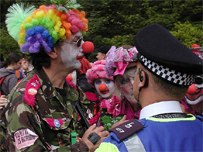
 As the Clown Army, a theatrical troupe of peace activists, do their �pacification of authority� routines, the police decide to close down the party.
