
|
|||||||||||||||
|
MEDIA
Media complicity and the economy of double-speak Through the language of “objective” reporting, the mainstream media are bowing before the establishment and raw corporate power
by John Hilley
It is notable that while the daily diet of death and destruction continues unabated in Iraq, it has quietly slipped as a headline story on mainstream news. Not that BBC coverage of the war, with a few belated exceptions, has ever strayed beyond ‘safe’ reporting limits. But with the ‘mission to deliver’ Iraqi elections and a parliamentary process now apparently accomplished, media editors and journalists have settled more easily into extolling the occupation (a word never used) as a force for good. Recently, in Edinburgh, I had the privilege of hearing Noam Chomsky dismantle the language of “benevolent intervention” proclaimed by Western leaders and those who have hitched themselves to the democratisation bandwagon in the Middle East. Also, on the subject of double-speak, Chomsky talked of the propaganda system’s remarkable ability “to make people feel helpless” — particularly in America where the populace is so massively assaulted by corporate ideology. Selective media coverage and omission play a critical role in both processes. In a revealing interview, the former BBC Middle East correspondent, Tim Lleyellyn, has pointed to the institutional caution of the BBC in reporting the real story of Israeli occupation in the Palestinian territories. Afraid of upsetting the Blair government and Jewish lobby, he detects within the BBC a disturbing self-censorship, approximating to editorial and journalistic cowardice. This is also, he believes, part of a more pervasive trend towards “surface reporting” and superficial output as bodies like the BBC compete in the fast-news corporate-media environment. Thus, as news editors circumvent the sensitive, the voices of brutalised Palestinians are being rendered helpless. The deficiency of force Where helplessness prevails, violence often fills the vacuum. But while this has proved disastrously futile in the Palestinian case, the media are also guilty of misrepresenting such resistance. As Llewellyn notes, BBC reportage has consistently failed to contextualise the social and political psychology of the suicide bomber. Llewellyn also links this to the preponderance of correspondents based in Israel rather than the Palestinian areas. One of the most hopeful features of the Israeli-Palestinian conflict has been the courage of peace groups and military refuseniks in Israel. Yet, again, little of this or the substantial Israeli public voice opposed to Sharon is being aired as mainstream news. Thus, as with the largely biased reports over Iraq, a quiescent media is helping to prolong Palestinian suffering. And, as their resentment intensifies, we see not only bloody retaliation in Israel, but increased hatred of Jews across the world. It seems a bleak and unremitting picture. Yet, as Chomsky reminded us, while the US and Israel have predominance in “the arena of force”, people hold more influence than they think in “the arena of political power”. Bush and Sharon may retain disproportionate military strength, but they struggle to legitimise that authority in the face of informed public opinion. In short, knowledge, moral argument and non-violent action are still the most effective weapons we have. System and illusions Part of that process involves challenging the sacred illusion of media impartiality. For the writer and academic Robert W. McChesney, tight corporate ownership and neoliberalisation have locked international and local media into new conformist relations, dumbing down the news, abbreviating information and narrowing the space for critical journalism. Emerging particularly in the US, mainstream media, he believes, have taken refuge in the polite fiction of “professional journalism”. For McChesney, this is really “tepid journalism”: a narrow, consensual understanding of permitted reportage “that reflects the range of existing elite opinion”, reinforcing a “conventional business-as-usual politics” which “marginalises the new, the critical and the radical, especially if they are threatening to entrenched economic interests.” In the crucial arena of war, a state inclination which “requires the greatest democratic monitoring” by the media, “professional journalism has proven to be mostly a stenographer to those in power.” McChesney’s words overview Who Owns the Media?, where, in a later chapter, Zaharom Nain (the book’s co-editor) and Wang Lay Kim trace the political coercion and incorporation that has shaped safe media output in Malaysia. Charting the evolving network of BN ownership and control, the authors note, for example, how The Star returned as a “pale copy” of itself after the suspension of its licence during Operation Lalang. And, as the continued harassment of Malaysiakini and Harakah suggests, the threat of closure and arbitrary arrest remains a none-too-subtle reminder to other would-be critical organs. However, Malaysian media output is also predicated, as elsewhere on the wider corporate order. As McChesney notes, the media structure in general “presupposes the capitalist status quo as the natural and proper democratic ordering of social life.” And these assumptions serve a lifetime purpose in shaping the corporate ideal of the passive-citizen-active-consumer. Thus, driven by advertising demands and circulation wars, proprietors and editors churn out evermore mind-numbing trivia and celebrity vox pop, while serious current affairs is subsumed to routine party politics and safe editorial-speak. Reflecting the corporate fundamentals which media organisations live by, political life is reduced to just another set of commodity choices. Complicity and respectable politics Where critical comment does appear, it is usually conditioned by a learned deference to power. For instance, when Paul Wolfowitz was given the nod as head of the World Bank, some media could not help but note the man’s dark reputation and directorship of the Iraq war. What they mainly failed to do was ask why he was not being arraigned before an international court. This is a good example of how the media and political class sanitise the actions of those who use the respectable offices of state to sanction mass murder. Complicity is not just about direct association in a crime. It is also the act of excusing a crime by hiding behind the mask of ‘professional detachment’; in the media’s case, through a language of ‘objective’ reporting which allows the powerful to maintain an aura of legitimacy even where their actions are patently criminal. Again, a good part of this lies in the type of Western bias which can condemn Saddam or the perpetrators of genocide in Darfur, but would balk at declaring Bush or Blair responsible for crimes against humanity. Likewise, while Mugabe’s human rights abuses headlined the recent election in Zimbabwe, few media scribes thought fit to mention the loss of 100,000 lives as the price for Iraq’s ‘first free election’. As consistently observed by MediaLens, liberal media like the BBC and Guardian are notable exponents of such vacillation. Typically, this involves whitewashed editorials and selective kow-towing to senior politicians. For example, in a recent piece, the ML editors note how the leading BBC correspondent Matt Frei was moved to praise Wolfowitz as a “powerful intellectual” who “believes passionately in the power of democracy and grassroots development”. (Contra Anwar’s approval, I also welcome the Wolfowitz appointment, a posting which may finally expose and hasten the demise of this bogus, undemocratic institution — see George Monbiot’s excellent rendition of this argument.) Of course, not all journalism is slavish endorsement of the powerful. Real critical journalism still prevails, as demonstrated by people like John Pilger. Yet, institutional deterrents and self-censorship serve to limit and temper dissident tendencies. Much of what passes for critical press and broadcasting comes with ‘career considerations’ and a predisposition towards ‘in-house’ values. I am reminded here of the classic interview with Chomsky where Andrew Marr, now chief BBC political correspondent, proclaims the ‘reality’ of journalistic freedom. Chomsky’s response, like his disposal of the ‘benevolent intervention’ argument, is a clinical dissection of Marr’s own capacity for self-deception — a prescient analysis given Marr’s current apologetics for Blair’s Iraq actions and Attorney General Lord Goldsmith’s ‘change of mind’ over the legality of the war. In another case of selective treatment, the anti-war Respect politician George Galloway has been cast as a major hate figure by the British and international media. In stark contrast to the respectful treatment of politicians responsible for mass killing in Iraq, Galloway’s stunning election victory in London’s Bethnal Green (a welcome surprise even for this writer), overturning Blairite Oona King’s 10,000 majority, was met with grudging acknowledgement and a particularly venomous attack by the BBC’s ‘chief interrogator’ Jeremy Paxman. Having already seen off the Telegraph and Christian Science Monitor in the libel courts, Galloway added to the media’s discomfort with a dynamic performance before the US Senate’s oil-for-food hearing. There, he dismissed more ‘oil beneficiary’ smears and reminded the chastened senators of who has really profited from the sanctions policy and occupation. On this occasion, media ‘praise’ seemed rather more forthcoming. Yet, it remained fixed on Galloway’s ‘controversial’ and ‘maverick’ personality, rather than the politics of an elected MP articulating widespread anti-war feeling. As arbiters of news, frontline reporters and celebrity broadcasters like Paxman are part of a safe media establishment which regards dissident voices like Galloway and Pilger as irritant threats to ‘respectable’ politics and professional journalism. Within this sphere of influence, ‘acceptable’ views and values are mediated and forged, helping to marginalise the ‘awkward squad’ and patrol the parameters of debate. (Paxman’s own off-screen activities include membership of the elite British American Project, a proto-Blairite/corporate-founded network of movers and shakers, which Pilger describes as a “casual freemasonry” of “the most influential transatlantic... politicians, journalists and academics”.) Through such patronage and ‘critical exchange’, editors and journalists come to reproduce, consciously and subconsciously, an assumed version of political life which transcribes to the public as deference to liberal institutions and corporate power. This is the most subtle aspect of media output; a system which can instil from within the self-delusional values of unfettered journalism, producing, in turn, a standard vernacular which becomes lodged in the minds of media personnel and public alike. To conclude, here are a few examples of commonly repeated terms and references to illustrate the point: Free world Freedom and democracy The leitmotif of liberal capitalist order. Assumed project: ‘we, the free world’ offer this to ‘you, the non-free/other’. Free elections The proclaimed standard of free societies. Free media The badge of objectivity and truth — or being free to report what Mr Murdoch allows. Free market Abstract economic concept accepted as given reality. Free trade (benefits of) Tell the people of Africa. Economic progress Liberalisation Adopted corporate-speak for the neoliberal appropriation of all economic and social life. See ‘Wall Street consensus’. Economic growth Benchmark of national success: increased output promises more consumption, affluence and social prosperity. Wealth creation Supersonic salaries for the one-percenters, anguished aspiration for the middle classes, cheap jobs for the rest. National development Keeping the populace focused on ‘higher’ aims while they languish in poverty; as in the ‘new’ South Africa. National interest Precisely whose? Fear factor International community Those adhering to Washington’s ‘unilateral multilateralism’. International terrorism Anything questioning US terrorism. Popular Bush-ism: ‘you are either with us or against us’. Failed/rogue states Standard pejorative employed by mainstream media. See also ‘axis of evil’ and Reagan-esque ‘basket case’. Weapons of Mass Destruction/WMD Imprinted word association — ignoring US/ UK arsenal of death and Israel’s nuclear capability (as revealed by Mordechai Vanunu). War on Terror Generic reference to unspecified threat from unspecified other. Legitimating language for Guantanamo, Bagram, Belmarsh and Kamunting. Incursions The Israeli ‘Defence’ Force (IDF) launch these into the West Bank, according to prime-time news. Alternative reading: ‘daily death squads murder innocent Palestinians’. Insurgents Loaded media label for indigenous peoples engaged in legitimate resistance against illegal invaders. Muslim world Jihad Mainly peaceful cause/aim used as fear-instilling term by Western media. Suicide bomber Potentially all Palestinians according to same media. Moderate Islam As in Blairite invocation to ‘friendly face of Islam’ — or, ‘come together in dialogue while we kill your brothers in Iraq and Afghanistan’. Taliban fanatics Old friends of Washington used against the Soviet foe. Feted in the US, pre-9/11, on behalf of Unocal oil. Saudi allies Bush Inc. oil deals and foreign troops on holy soil. The 9/11 hijackers came from where? Osama still at large The ‘Muslim threat’ personified. Threat from Iran Manichaean neo-cons play media clever: how to peddle suspicion, destabilise the mullahs and spread ‘democracy’ beyond Baghdad. Please support our work by buying a copy of our print publication, Aliran Monthly, from your nearest news-stand. Better still take out a subscription now. If you prefer to read our web-based edition, please support our work and make a donation.
Now tell us what you think in fewer than 250 words. Your comments may be published in the Letters section of our print magazine, Aliran Monthly. | |||||||||||||||

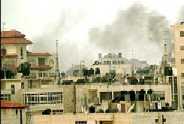
 Thus, as with the largely biased reports over Iraq, a quiescent media is helping to prolong Palestinian suffering.
