
|
|||||||||||||||
|
POLITICAL ECONOMY
Putting compassion back into politics How authoritarian laws and market demands are threatening social cohesion
by John Hilley
Norlaila Othman�s informed and moving account of the brutal treatment of her husband and other ISA detainees at Kamunting; Dr. Jeyakumar Devaraj�s searing indictment of the government�s plans to privatise dispensaries (part of the creeping corporatisation of Malaysia�s healthcare system); and Angeline Loh�s brass tacks account of poor parents struggling to meet the basic costs of their kids� education. In sum, state repression, free market �solutions� and lifetime anxieties for those on the social margins. But, all this is being validated by a related social tendency: �unforgiving individualism�. Blame culture In Malaysia and elsewhere, the state has now relinquished any serious ideal of progressive intervention. Its raison d��tre is to facilitate private capital and manage the social crises of market life. In a world of neoliberal expansion, war and social displacement, this has seen an all-encompassing surveillance agenda to contain dissidents, protesters, would-be terrorists, economic migrants, asylum seekers and errant youth. And with this comes a blame culture which castigates those at the bottom as failed market competitors. In Britain, the wealth gap under New Labour is now wider than it was under Thatcher. The Blair government claim to be cutting unemployment and extending �choice� � another Thatcherite mantra. In reality, millions are living in economic neverland, caught between the �poverty trap� options of subsistence - rate welfare benefits or low-wage employment with minimal security. Criticising Britain�s �low pay culture�, the poverty campaign group, Rowntree, estimates that �12.4 million people (22 per cent of the population) live in households with net incomes below the poverty line.� In Shettleston, part of Glasgow�s marginalised east end, a recent report found that life expectancy for males is 56 years, 14 years below the national average. In schools around here, kids turn up for classes malnourished, many lacking the basic stimuli to engage and learn. Politicians and �development� agencies have sought to tackle this disgrace through �social inclusion� initiatives and �new economy� employment as a supposed route out of poverty. But exclusion and alienation cannot be turned around by lofty words and cheap-rate, service sector jobs. Unsurprisingly, voter turnout in such areas is among the lowest in the country. The political class in Scotland are also presently exercised by the problem of anti-social youth behaviour, or �ned culture� (akin to �lepak culture�) to give it its catch-all label. Fear, loathing and ridicule of the ned � �non-educated delinquent� � is standard fare at the middle class dinner table. Anguished columnists talk of social breakdown. Dismissals are also made of ned behaviour as a class issue. It�s a �culture thing�, they insist, with notional references to baseball caps and other peer attire. Of course, youth and society is a multi-dimensional issue. Much of the social glue which once bound communities more closely together has come unstuck. Neither can we understate the real fear and violence experienced by vulnerable citizens. Everyone has the right to feel safe and protected. But youth �delinquency� (a much abused term), like poverty, is also the product of long-term policy directives and structural decisions, notably the economic abandonment of entire communities to the mercy of market forces. It is no coincidence that the vast majority of such youngsters come from poor areas. Whatever the cultural factors, that�s a class issue in my book. Moreover, what can we say of a schooling system that turns out so many �non-educated� children? Here, unforgiving individualism offers a ready rationale for displacing the blame and extending state powers. Branded as �juvenile terrorists�, the government is now imposing new punitive Anti Social Behaviour Orders (ASBOs) in record numbers, a criminalisation approach which, as many child-care organisations have warned, will only compound the problem. Additional �name and shame� proposals suggest yet another turn to lynch mob solutions. In similar vein, the �menace� of �benefit-seeking foreigners� has seen New Labour and the Conservative opposition compete for title of toughest party on immigration. A vicarious tabloid press, meanwhile, stoke the fear with �horde invasion� headlines. But white, Daily Mail prejudice does not tell the whole story. In UK cities with mixed ethnic concentrations, we hear �successful� young Asians in BMW cars expound on �layabout�, �job-shy� Afro-Caribbeans. Again, the stereotype antipathies suggest a more corrosive undercurrent of malign individualism. Market culture is obscuring the real political and economic context of immigration, �problem youth�, asylum seekers, benefit claimants and other social issues. And the disturbing outcome is a creeping lack of empathy, and visceral hatred, towards marginal groups. Selective compassion Informing all this is the psychology of fear and consumption. Competitive life is giving rise to a dangerous authoritarian populism; the ready sacrifice of civil liberties for �consumer liberties�. People are being conditioned by state-induced anxieties and the incessant logic of market survival: thus, oil-guzzling Americans turn a blind eye to torture in Guantanamo and Iraq; at the opening of an IKEA furniture store in London, someone is stabbed in the rush to secure a bargain. From shopping rage to support for emergency laws, a pernicious selfishness is threatening social cohesion. And here�s the sting: as many studies now show, the more we consume, the less happy we seem to be. When asked recently why he, like others, had little faith in mainstream politicians, the black radical poet Benjamin Zephaniah put it succinctly: �They�ve lost their compassion.� Things some would never have once said, they now say, he notes, because they have positions and careers to protect. It�s an acute summary of the dark rationalisations made by those in political office. Yet, selective compassion also permeates the wider society. Craig Murray was recently removed as UK ambassador to Uzbekistan for revealing Uzbek torture of Al Qaeda suspects and British complicity in the process, a brave exposure of the UK�s �no torture� policy. But what also concerned him was the lacklustre media coverage and public reaction back home. Why, he wonders, are people so seemingly unconcerned about their government�s shameful conduct? Indeed, we may ask, why is there such muted concern for the plight of detainees generally? One can only surmise similar ambivalence towards ISA prisoners. We proclaim universal principles of human rights. But how much care is really felt when it�s a �suspect� person in an anonymous jail? There is a deep paradox here. We have just witnessed genuine and generous response to the tsunami disaster. This, in turn, has raised the debate on aid, debt, unfair trade, poverty and global conflict. So, people do grasp the bigger picture, albeit in general terms. Yet, at home, narrow individualism persists, fostering an often harsh vigilantism in �defence� of the private consumer. But it is a politics of the self which only intensifies fear and disorder. The roll call of decline As the UK General Election approaches, I ruminate on the roll call of leaders who have marked this decline. Heath, Wilson, Callaghan, Thatcher, Major and Blair: a line of prime ministers from the seventies who saw Britain through �one nation� Toryism, the �winter of discontent� and Thatcherite individualism, before morphing into vacuous New Labourism with its even darker prostration at the altar of market forces. Thatcher was, of course, the turning point. Today, that name can still evoke bad memories, particularly here in Scotland. Blair, in contrast, was always more enamoured of the Iron Lady, adapting her obdurate certainty into a righteous unyielding of his own. �Things Can Only Get Better�, ran the adopted New Labour pop song in 1997. A new dawn, proclaimed the PM, entering Downing Street on that sunny July morning, confirming, for the less euphoric, the emptiness and manipulation to come. Eight years on, the results: stealth privatisation, erosion of public services and an �anti-terror� agenda that even Thatcher would have blushed at. But while Thatcher oversaw industrial meltdown, denial of society and jingoistic war in the Falklands, Blair will have to live with the catastrophe of Iraq. Whereas Mrs. T was, at least, the genuine article of �conviction politics�, Blair will be remembered as the smiling trickster, par excellence. Waiting in the wings, sits Gordon Brown. At his acolytes� behest, the brooding Chancellor is now attempting to summon up some caring-sharing street-cred. As his recent African tour suggests, this includes a new enlightened take on aid and debt relief. But Africa and poverty concern are strange habitats for someone more at home, stateside, with Wall Street financiers. Blair may be taking the flak over Iraq, but Brown, as New Labour co-architect, remains the backroom ideologue of market liberalisation. The stuff of nightmares If Malaysians have seen Vision development and �boleh nationalism� used to fashion political consent, they will be familiar with the coercive instruments underlying it all. In similar ways, Blair�s feelgood catalogue � high-growth �prosperity�, the home-owning equity boom and assorted takes on �Cool Britannia�� has been accompanied by a much darker assault on civil liberties. In December 2004, the law lords, led by Lord Hoffman, ruled that detaining terrorist suspects without trial was grossly unlawful, breaching the European Convention on Human Rights. The ruling centred on eleven men held under emergency powers at Belmarsh prison. Other conservative law lords were likewise alarmed at the government�s disregard for statutory rights. Lord Scott called the executive�s use of the Terrorism Act (2001) in this instance: �the stuff of nightmares, associated with France before and during the revolution, with Soviet Russia in the Stalinist era, and now [through] the 2001 Act, with the United Kingdom.�Home Secretary Charles Clarke has now responded with other unprecedented measures, including house arrest. Under these powers, any suspect, foreign or British, can be forcibly domiciled, curfewed, tagged and denied other basic rights. Facing parliamentary opposition, and limits on the bill�s passage before the existing legislation expired in March 2005, the government conceded that judges could give rulings in some of these cases. Yet, with or without judicial review, this still falls far short of due process, allowing the minister extensive new authority to impose control orders. During the Commons debate, many MPs likened the proposals to the apartheid laws in South Africa. With other curbs on civil liberties, this now confirms New Labour as the most authoritarian government in modern British history. Profit, negligence and abuse But the attack on habeas corpus is just part of a wider extremism in support of big business. Corporate freedom is multiplying as sacrosanct legal standards are being eroded. Yet, ominously for Blair, it is the courts which are serving to expose this free-market promiscuity. For example, five company directors are currently facing corporate manslaughter charges for the fatal Hatfield train crash (2000). Here, the court heard how a broken track which caused the disaster lay unrepaired for two years, just one of the many cost-saving practices prevalent within Britain�s privatised rail service. In other Private Finance Initiatives (New Labour-speak for privatisation) some local councils are in legal dispute with the PFI companies contracted to maintain public buildings. One big player, Jarvis, now removed from its rail contracts for negligence, is facing criticism over cost-cutting work and maintenance in British schools. Likewise, hospital standards have declined alarmingly since the privatisation of ancillary services, a particular concern being the MRSA superbug which thrives in unhygienic wards. Private security firms are also engaged in routine abuse of asylum seekers within Britain�s detention centres. In a recent BBC film, undercover reporters exposed the racist, violent practices of one such company: Global Solutions Ltd. The name says it all. Mood moment Across the world, experience teaches us that reform and social rights always have to be fought for. And that reality is no more immediate than when a loved one is being beaten and humiliated in a prison cell, when a person�s life is jeopardised to facilitate private health corporations, or when poor people struggle to meet the basic costs of their kids� upbringing. Despite the unforgiving tendencies noted, there is a growing frustration in Britain, finding voice in the vacuum of parliamentary politics. With the Conservatives widely distrusted and the Liberal Democrats still viewed as sideline players, Blair knows that the electorate have nowhere else to go. It�s a bit like having the only shop on the island. Many, particularly the young, feel not only disenfranchised under the first-past-the-post electoral system, but resentful at the lack of real alternatives and complacent smugness of New Labour. How do we confront this problem? One logical strategy is tactical voting, an option favoured by many Labour voters disgusted at Blair�s conduct over Iraq. A number of campaigns and websites have also been dedicated to reducing Blair�s majority, forcing coalition government and securing a preconditional commitment to proportional representation (PR). The aim here is to neutralise New Labour and seek a fairer system like the Scottish Parliament. However, with the main parties nowhere near the level of co-operation required to effect such change, this is still a long-term task. Should we refuse to vote, thereby pushing the system towards an ultimate crisis of legitimacy? This is already happening, not only as apathetic rejection, but as conscious disengagement. However, I am not convinced that the long, hard struggle for suffrage should be so easily sacrificed to anarcho inclinations. Ultimately, we still need parties and legislative structures. The point is to make them more participatory. Small left parties like Respect and the Scottish Socialist Party will not win a single seat under the present Westminster system, but they are building steady support for an alternative grassroots politics. Can direct, on-the-ground politics help enliven the process? While this may seem the stuff of banner-waving protest, it is also encouraging wider and more sophisticated networks of radical organisation. That will be apparent in Scotland this July with mass demonstrations and assorted �guerrilla activity� at the G8 summit in Perth. An estimated 200,000 people are also expected to converge on Edinburgh in a Make Poverty History march, a statement of collective anger at the corporate imperatives which are enslaving poor countries, wrecking societies and threatening environmental doom. Again, the response is predictable. The authorities are gearing up for the most repressive containment operation ever mounted. All police leave has been cancelled, special courts are on emergency standby and selected holding cells are being prepared for mass G8 custodies. Protest groups are under surveillance and the public is being urged to report �suspicious activity�. As the big capitalist powers assemble at the luxurious Gleneagles Hotel, we will hear much talk of eradicating third world debt and tackling poverty. But the policing measures reveal the summit�s more pressing purpose: to impose more structural privatisation on poor countries and find ways of managing the social fallout. In turn, the G8 Alternatives campaign will demonstrate to Blair and his elite guests that more people are becoming informed about the real causes of poverty and injustice, global and local. Hopefully, that will encourage a more compassionate politics at large. Please support our work by buying a copy of our print publication, Aliran Monthly, from your nearest news-stand. Better still take out a subscription now. If you prefer to read our web-based edition, please support our work and make a donation.
Now e-mail us and tell us what you think. Your comments might be published in the Letters section of our print magazine, Aliran Monthly. | |||||||||||||||

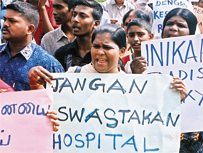
 ...more people are becoming informed about the real causes of poverty and injustice, global and local
