
|
|||||||||||||||
|
DETENTION WITHOUT TRIAL
‘Riot’ at Kamunting: The real story Detainees were targeted because they had campaigned for their freedom, claims homemaker-turned-activist
by Norlaila Othman
Aliran Monthly Vol 24 (2004): Issue 11/12
Please support our work by buying a copy of our print publication, Aliran Monthly, from your nearest news-stand. Better still take out a subscription now. If you prefer to read our web-based edition, please support our work and make a donation.
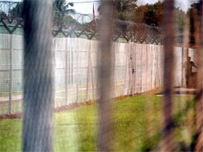
Normally, during our visit, my son and I would be able to shake my husband’s hands (salam) and later my son would climb on his back. My husband would take a few paces up and down and both of them would giggle happily. Nothing separated us during our previous meeting. But today, 19 December 2004, our meeting was not a normal one. We were denied everything. I felt as if I was in a prison. Over the last two weeks everything was quite fine, but on this day, after the reported ‘riot’, he was treated by camp authorities like a prisoner - not as the detainee that he was. Well, why do I think that my husband, ISA detainee Mat Sah Mohd. Satray, should not be considered a prisoner? It is because he has been detained here for more than two years and up to now he has not been charged or given a fair trial in an open court before an independent judge. He was alleged to be a member of a group referred to as Jemaah Islamiyah, which is said to be linked to Al-Qaeda, and he was perceived to be a threat to the country. Strangely, however, such a serious, high-profile allegation didn’t qualify him for a fair trial unlike any other suspected criminals in Malaysia. His good name and image has been tarnished in the media but he hasn’t been given the chance to defend himself. We were married in 1990. He always told me that we should have at least 10 kids, but until now, Allah has rewarded us with only a boy named Suhaib, aged 11. In both our families, our siblings considered my husband as the most pious one. Being a soft spoken and amiable man, he never raised his voice even when he was angry. He had no Islamic education background but he loved to fill his free time reciting the holy Qur’an. He has a small one, which he carries in his chest pocket everyday. The worst night For two and a half years, my son and I have lived without him. I can still remember how, on the night of Wednesday, 17 April 2002, my husband was handcuffed as he opened the gate to welcome our ‘guests’ who dropped by in the middle of the night. A group of 12 men dashed into our single-story house in Taman Keramat and raided the whole area, including the ceiling. After four hours of ransacking, at 4.30 am, they took my husband, my CPU, my son’s CD games, my handset, my file on Islamic Studies and a camera. My son began to cry when the van with my husband inside cruised out of our sight. I held my tears and didn’t cry at all. I consoled my son, and later he slept on my lap. The next day, my friends came to my house and they said that my eyes were swollen. I learned about the allegations hurled at him from the mainstream media. On the first day of his arrest, he was alleged to be a member of the so-called Kumpulan Militan Malaysia (originally referred to as Kumpulan Mujahidin Malaysia), but after 60 days, he was alleged to be a Jemaah Islamiyah (JI) member! My first steps In the early days of his detention, I was just a naïve and innocent working wife/homemaker. I didn’t know much about the ISA. I also felt under siege. I had never met any human rights activists or lawyers. It was Aliza Jaafar, wife of ex-detainee Saari Sungib, who was the first one to discover me. She gave me a lot of books on the ISA written by her husband. Then I began to understand that my husband was also a political detainee. I hate the ISA so much because it has not only violated my husband’s rights but has also taken away all the happiness in our lives. And my hatred towards the ISA slowly broke the wall of fear inside me. I had no choice but to fight it for the sake of our rights. And when the ‘Reformasi Six’ were released, I took my first steps in the struggle together with the human right activists. I came to know that the Abolish ISA Movement’s (GMI) Family Support Group (PSK) was actively engaging other detainees’ wives. As the days rolled by, I found that my days were really packed with activity, mainly providing support to the families of the other detainees. As a graduate from a local institution, it was easy for me to understand the human rights activists’ struggle against the ISA. I used to participate in student activities during my campus life more than ten years ago. I’m also a member of Jamaah Islah Malaysia (JIM), an Islamic NGO that is actively involved in contributing towards social welfare in Malaysia. These experiences actually helped me a lot to relate to the other human rights groups in GMI. I didn’t have much trouble getting myself involved in the campaign as I received warm support from my close friends in JIM. I began to get acquainted with lawyers and reporters. I learnt how to make good statements and later began to write. My first writing was published in the PAS organ, Harakah, in Nov 2002 while a few others came out in Malaysiakini later in 2003. I also began to give talks about the ISA to small groups of women. During the 11th general election, two other detainees’ wives and I helped a few Barisan Alternatif candidates in their campaigns. An orchestrated 'riot' On 8-9 December 2004, a so-called “riot” erupted at the Kamunting Detention Centre, where some 100 detainees were being held. It received front-page treatment in the New Straits Times and Berita Harian and it was reported that weapons were found in the security camp. The “riot” actually started from a spot check, a normal procedure carried out by the Prison Security Unit (UKP), at Block T-2B, one of the blocks in the camp. At 9.00 am, the detainees in the block were shocked to see a large number of UKP officers dashing into their block and simply taking their belongings, especially tools and material to make handcraft. They tried to stop the action of the UKP but there were too many UKP personnel and 12 detainees inside were beaten up badly. Detainees make handicrafts like tissue boxes, jewellery cases, pencil boxes and flower vases using tools such as blades and scissors supplied by camp authorities. They managed to make hundreds of beautiful items, and some of the detainees’ wives helped to sell them a few months before Ramadan, the fasting month for Muslims. Sales reached almost RM15,000 and proceeds were used to buy supplies and amenities for distribution among 40 families for the Hari Raya celebration. Up to the time of writing, no family member has been allowed to visit the detainees involved in the incident. The camp authorities admit that there were a few detainees sent for medical check-up, but they will only allow visits in two or three weeks from 8 December, the day the detainees were assaulted. One of the family members of the injured detainees managed to get a report from the Taiping Hospital: a doctor himself confirmed that the pattern of the injuries suffered by the detainees was consistent with those who had been bound and beaten. When families are finally allowed to visit the victims, the wounds and bruises would have surely healed without a trace by then. The spot check that day didn’t end with Block T-2B alone. The UKP raided all the other blocks as well. All detainees gave their cooperation to the UKP. Then at 4.30 pm on 9 December 2004, a group of 24 detainees, among whom was my husband, was totally shocked when suddenly there was a second spot-check specifically at Block T-4. All 24 detainees had their hands handcuffed behind them. All of them were instructed to bend down and each was held by his beard by a UKP officer. They were forced to walk in a single file to another block. Along the way, they were kicked, beaten, punched and spat on by more than 50 UKP officers including some of the wardens. The UKP officers also took the detainees’ belongings comprising books, badminton racquets, clothes, shoes, family pictures, letters, magazines, AIM handouts and also dry food. At the time of writing, their belongings have not yet been returned to them. Not only were they treated like a flock of sheep, most of them were elbowed, punched and choked. They were also verbally abused with words like “babi dalam kandang” (pig in the sty). Even though they didn’t resist, they were kicked and punched a number of times. The kicking and beating was done so hard that some of them suffered from bruises and slipped disc. One UKP personnel choked my husband while another elbowed him hard, throwing him to the floor. All the time, my husband had his hands handcuffed behind his back. After the medical check-up last Thursday, 16 December, six days after the incident, the x-ray scan showed that he had a fracture on one of his left rib bones. The x-ray scan was sent to the orthopedic section for further investigation. The group of 24 was then separated into three smaller groups. Two groups, each comprising eight members, were put in two different dorms while another eight were put in solitary confinement. The wives of the 24 detainees involved made police reports and urged their lawyers to study the torture incident and look into the possibility of suing the newly appointed camp director, Tuan Yusaimi Mohd Yusof. A day after the ‘riot’, the detainees’ lawyers tried to visit them but were denied permission by the camp officers. Subsequently, a group of two commissioners and two officers from Suhakam was allowed to visit the victims. A day after his visit, Prof. Hamdan, one of the commissioners, in fact suggested that the detainees should be charged in court or released. Vocal detainees beaten According to the latest data, 73 detainees are alleged to be JI members and 7 are alleged to belong to KMM. Nik Adli, the son of the Menteri Besar of Kelantan, is one of the detainees. The detention of the KMM members is coming close to its fourth year. Most of the 24 beaten detainees in Block T-4, including my husband, had been detained for more than two years. They were alleged to be JI members. At the beginning of their detention, they thought that if they followed the camp rules and listened to the Special Branch officers, they would be released fast. This position changed in June 2003. The Reformasi group was released right away after two years of detention, whilst the detention of the most obedient group, Al-Maunah, was renewed. The detainees then begin to engage lawyers. Then, in September 2003, 31 of them made a statement that they were not JI members as alleged by the media. At the same time, 10 of them (including those who were beaten) filed their habeas corpus applications with the help of Chooi and Co. The case was heard in December 2003 and later adjourned to February 2004. The court rejected their applications but they later filed an appeal to the Federal Court. In March 2004, a few weeks before the 11th General Election, the 24 detainees supported the alleged KMM members in their hunger strike. They rejected meals provided by the camp. On 19 April 2004, the 24 detainees submitted their memorandum on the alleged torture inflicted by police during their 60-day detention at the Police Remand Centre. Later, three of the detainees’ wives, including me, lodged reports at the Dang Wangi Police Station. In early May this year, the whole world was stunned by revelations of inhumane treatment by US soldiers of Iraqi prisoners at Abu Ghraib prison. Suddenly, the same group of ISA detainees came out with sketches of the torture inflicted on them by their interrogators during the first 60 days in the Police Remand Centre. The sketches showed that the torture was very similar to that experienced by the Iraqi prisoners. The Deputy Internal Security Minister, however, described the sketches as ‘naughty boys' drawings’. The same Deputy Internal Security Minister, Noh Omar, said that the allegations by the detainees were aimed at tarnishing the country’s image. On 28 May 2004, for the first time in the history of the security camp, the camp authorities opened the place to reporters from all over the world to show that there was no torture in the camp. It was however noted that Noh Omar didn’t bring reporters to Block T-4, the place where the 24 of them were held; instead, he went to meet them alone, thereby angering the detainees. Later, in July, the same group sued Election Commission chairman Abdul Rashid Abdul Rahman for denying them their right to vote. They won the first round and the case will be heard soon. In August this year, the same group sent a memorandum to the Perak Mufti, Harussani Zakaria, who is also a member of the Malaysian Muftis Council, urging the council to declare the controversial ISA as ‘haram’ from an Islamic point of view. As we go through all these memos, we can understand why the detainees’ counsel, Edmund Bon, has said that this group appeared to be targeted by their assailants. They had done a lot of things just to highlight that their detention was unlawful. It seemed that the detainees had tried every which way to publicise their detention, but their captors refused to free them. Instead, they were badly beaten, leading to a deterioration in their health. The real victims of the ISA During the first year of the detention, families might still have a certain amount of savings to survive. But after two years, life gets more difficult, as the needs of the children increase. Before the husbands were detained, the income of these families was estimated to be in the range of RM2,000-10,000 per month. But now, they have lost everything. A homemaker with seven kids in Ampang Jaya lost much of her husband’s business valued at RM12 million and now she has started doing small catering to earn a living. Most of these wives are fulltime homemakers. Without proper qualifications and experience, it’s hard for them to get jobs in the open market. Some of them got involved in direct-selling or small-time catering to earn a livelihood. Some of these wives received money from the Welfare Department but it was too little to meet their daily needs. Furthermore, it is not easy for the wives to receive aid from the Welfare Department, as they have to undergo a series of interviews with the officers-in-charge. The latest data from GMI’s Family Support Group shows that only 20 per cent of wives have a stable income. About 80 per cent or 60 families are facing serious financial problems. At least 500 children are suffering from lack of a father’s love and attention. This year alone, two detainees’ sons were warded at HUKM due to mental illness. The idea that those who help detainees were considered to have links to terrorists made things worse. Most of the family members and close friends chose to keep quiet because they felt that they were also under siege! If they wanted to help, they would do it quietly. The ISA really succeeded in instilling fear in the hearts of the people. As for the wives, they not only suffered from the trauma of the arrest, but some of them also claim they were harassed by Special Branch officers. For example, a wife from Pahang, experienced miscarriage while she was seven months’ pregnant. Another wife from Perak had to undergo serious treatment and medication due to Post Partum Depression as her husband was taken away a few days after she gave birth. A Special Branch officer advised a wife from Selangor to get a divorce from her newly wed husband who was arrested four months after their wedding. The biggest threat The ISA is not a suitable law to safeguard the economic life and security of the country. National security means the safety and security of the people to ensure their rights are upheld. But the ISA is often used by the ruling political leaders to ensure they remain in power. For more than 45 years, the ISA has been used on all walks of people such as ministers, lecturers, students, and businessmen. The ISA actually is the biggest threat to the people. So far, over the years since Merdeka, more than 10,000 people have been detained indefinitely without trial. This draconian law must be abolished to make sure that future generations can live peacefully in a country that is free from the tyranny of the ISA.
Now e-mail us and tell us what you think. Your comments might be published in the Letters section of our print magazine, Aliran Monthly. | |||||||||||||||

 One UKP personnel choked my husband while another elbowed him hard, throwing him to the floor. All the time, my husband had his hands handcuffed behind his back.
